Welcome back to my tech blog. As a Senior IT Architect, I deal daily with the scalability, performance, and security of modern software ecosystems. The hype surrounding Large Language Models (LLMs) has long since shifted into tangible IT projects, but to make the right architectural decision for enterprise or edge scenarios, we must look far beneath the hood of graphical user interfaces. In this profound analysis, we combine my solid foundational knowledge of system architecture and machine learning with the latest test results and legal evaluations of seven of the most popular AI assistants. The goal is to find out which system is truly future-proof in terms of inference latency, data retrieval, and compliance.
- The Ecological Architecture: Resource Consumption of LLMs in Focus
- Performance Benchmarking: 7 AI Assistants in a Rigorous Architecture Test
- Legal Frameworks, Data Governance, and Compliance
- Filter Architectures and the New Labeling Obligation (EU)
- Liability Models for Hallucinations
- Data Protection and Enterprise Readiness in the Licensing Model
- Conclusion: Upheaval instead of Collapse
The Ecological Architecture: Resource Consumption of LLMs in Focus
Every architectural design begins with hardware and operational resources. The exponential increase in required computing power for training and inference of foundation models presents data centers with massive infrastructural challenges. Let's look at the hard metrics: The initial training run of a GPT-3 class model architecture, based on 175 billion parameters, consumes approximately 1,287 megawatt-hours (MWh) of electricity. This corresponds to a CO2 equivalent of an impressive 502 tons or the annual emissions of 112 conventional cars.
In the pure inference phase (answering queries), modern, optimized architectures like that of the European provider Mistral shine: A typical system response comprising around 400 tokens generates only 1.14 grams of CO2. Nevertheless, macro-studies warn that the total power consumption of data centers for AI and digitization in Europe alone will escalate to over 150 terawatt-hours by the year 2030, even prompting IT infrastructure planners to consider reactivating decommissioned nuclear power plants to cover the base load.
Alongside energy density, water consumption for the thermoregulation of server farms is a critical bottleneck. By 2025, global water demand for pure AI operations is estimated at 312 to 765 billion liters. On a micro-level, this means: A typical chat session with 10 to 50 iterative prompts consumes about half a liter of water for cooling in the data center. Transparency is unfortunately scarce among tech giants here: While Mistral provides completely transparent metrics regarding its ecological footprint and Google at least partially discloses data, Microsoft and OpenAI almost entirely refuse the publication of reliable metrics regarding their environmental footprint.
Performance Benchmarking: 7 AI Assistants in a Rigorous Architecture Test
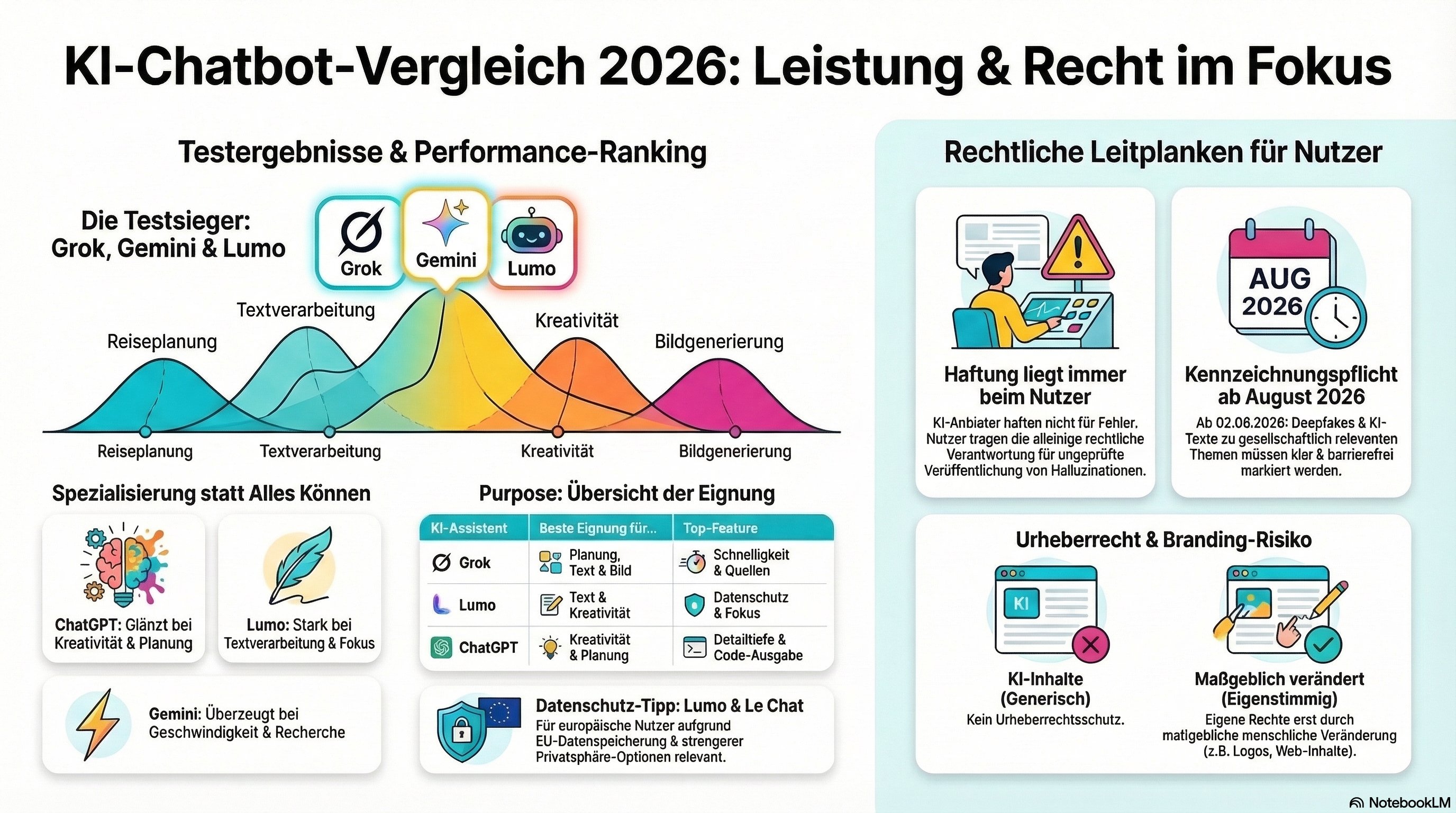
To evaluate the system efficiency of the endpoints, the chatbots were subjected to a practical test in four disciplines under strict token limitations. Tested were: ChatGPT (OpenAI), Copilot (Microsoft), Gemini (Google), Grok (X), Le Chat (Mistral), Lumo (Proton), and Perplexity AI. Models like DeepSeek, Claude AI, and Character AI were not included in the inference test due to registration barriers or compliance exclusions.
Test 1: Data Retrieval & Accuracy (Travel Planning)
The first task ("I am in Berlin for three days. What should I see?") tested the capability for retrieval and semantic classification of 13 predefined standard POIs.
-
ChatGPT: Captured 11 standard destinations, missed Potsdamer Platz and Kurfürstendamm. Latency: 28.2 seconds. Critical error: The information that the Pergamon Museum is closed until 2027 was hallucinated or ignored.
-
Copilot: 10 destinations, latency: 28.5 seconds, was the only one offering integrated location references via map.
-
Gemini: 10 destinations, extreme inference speed of only 11.6 seconds.
-
Grok: Best dataset with 12 captured destinations (only missed Potsdamer Platz) as well as 6 niche destinations. Latency: 20 seconds. Provided exemplary source references.
-
Le Chat: Only 7 destinations (missed Berlin Cathedral, Checkpoint Charlie, Potsdamer Platz, etc.) in 12.3 seconds. Hallucinated the opening of the Pergamon Museum.
-
Lumo: 8 destinations in 12 seconds. Also faulty regarding the Pergamon Museum.
-
Perplexity: 10 destinations in 14.3 seconds. Contained the Pergamon error and also a wrong cost database query (Deutschlandticket for 63.00 Euros). Benchmarking Conclusion Test 1: Grok and Gemini dominated in retrieval and accuracy, ChatGPT showed significant deficiencies in the recency of its vector database.
Test 2: Context Retention & Summarization (Text Processing)
Here, the complex original text regarding resource consumption had to be compressed flawlessly.
-
ChatGPT: Short sentences, inadequately structured. Lost hard numerical facts during vectorization, completely overlooked new fields of work, and captured the semantics of the last sentence incorrectly. Latency: 10 seconds.
-
Copilot: Structured very well as a list in 11 seconds, but omitted relevant competitors.
-
Gemini: Very good outline in 8.5 seconds, but lost the specific water consumption data for 2025.
-
Grok: Flawless and complete. Structured as a list in 9.5 seconds and offered an additional executive summary including sources.
-
Le Chat: Lost metrics regarding energy generation (9.9 seconds).
-
Lumo: Ignored details on nuclear power plants, otherwise extremely solid (9.3 seconds).
-
Perplexity: Very fast (7 seconds), but failed at fact reproduction regarding nuclear power plants and formulated subjunctives incorrectly regarding water consumption. Benchmarking Conclusion Test 2: The transformer models of Lumo and Grok proved the most stable attention mechanics and retained context the best.
Test 3: Syntactic Code Generation & Creativity
Generating a consistent CSS color concept matching the main color "Ruby Red a50021" separated the wheat from the chaff in terms of frontend support.
-
ChatGPT: Delivered extremely clear contrasts (3 colors + white + alternative) including clean CSS code in 18 seconds.
-
Copilot: Took 13.5 seconds, but refused to output copyable CSS code.
-
Gemini: Harmonious design (3 colors + black) with valid CSS code in a rapid 10 seconds.
-
Grok: Generated overly bright contrast colors and provided no CSS code in 11.9 seconds.
-
Le Chat: Lacked creativity, no code output (11 seconds).
-
Lumo: Very coherent concept, implemented an additional CSS code snippet perfectly in 15 seconds.
-
Perplexity: 7.5 seconds, but also without CSS code. Benchmarking Conclusion Test 3: Lumo and Gemini are clearly favored for web developers, ChatGPT also delivers excellent code at a higher latency.
Test 4: Generative Visuals (Image Generation)
The prompt requested a flat-design header with a PC motif in Ruby Red and Teal. Text-only engines like Perplexity and Lumo naturally failed immediately here due to system constraints.
-
Copilot: High detail density, but completely overloaded, took a massive 1 minute and 14 seconds.
-
Grok: Delivered two variants right away including code snippets in a measured 8.7 seconds (API specification: 6.6s).
-
Gemini: Recognizable, somewhat restricted Google design, rendered in 15.2 seconds.
-
Le Chat: Showed the highest visual individuality with complex patterns in 23 seconds (API specification: 9s). Benchmarking Conclusion Test 4: Le Chat and Grok generated the most convincing results visually and infrastructurally.
Legal Frameworks, Data Governance, and Compliance
As an IT architect, one must never send models into production blindly. The integration of AI systems significantly affects copyright law. Basic rule: Machines are not humans and therefore possess no copyright. However, almost all US providers reserve extensive usage rights to the training data and prompts fed by users. If AI bots act as web crawlers, they are on extremely thin legal ice when copying without citation. Architecture tests showed that currently only Perplexity, Lumo, and Grok are technically capable and willing to generate transparent and expandable link directories as proof of source. Should you wish to commercially implement AI outputs in frontends (such as AI-created company logos), trademark protection does not apply. Third parties could copy the logo perfectly legally, unless a human alters the generative base asset so profoundly that a significant level of human authorship exists.
Filter Architectures and the New Labeling Obligation (EU)
To protect themselves legally, providers build elaborate content filters into their pipelines. These block prompts aimed at child abuse, violent acts, weapons manufacturing, dangerous drugs, or harmful medical misinformation. As mentioned in the test, Grok's architecture ironically shows glaring gaps here when filtering misinformation. An absolute mandatory date for every tech stack in Europe is August 2, 2026. As of this deadline, a statutory labeling obligation for certain AI content comes into force. This includes manipulable deepfakes (image/audio/video) as well as machine-generated texts serving to inform the public about socially relevant topics. Violations will draw drastic cease-and-desist warnings and fines.
Liability Models for Hallucinations
Microsoft Copilot and Google Gemini warn directly in the UI: "AI can make mistakes." This is a legal disclaimer shifting full liability onto the end user. We must strictly distinguish between pure hallucinations (freely invented parameters), false information (outdated vector database entries), and targeted fake news/disinformation. Publications adopted unchecked can entail immense legal costs for the executing company, especially in the case of misinformation.
Data Protection and Enterprise Readiness in the Licensing Model
If we want to use AI in a GDPR-compliant manner, many models fall through the cracks. The Chinese provider DeepSeek is completely eliminated from the perspective of data governance in the enterprise environment. With US corporations like OpenAI, Microsoft, and Google, administrators often must mandatorily migrate to cost-intensive Business tiers to prevent training on company-owned data. For legally secure, data-protection-compliant use in the EU area, two European solutions primarily present themselves architecturally: Lumo from the Swiss security specialist Proton, and (with minimal restrictions) Le Chat from the French AI forge Mistral, which restricts data storage strictly to servers within the European Union. This is also reflected in the licensing. For a productive use case without massive functional restrictions, a premium subscription is indispensable. The monthly TCO (Total Cost of Ownership) is a favorable 7.99 Euros for Gemini, Lumo costs 12.99 Euros, Le Chat 17.99 Euros, while Claude AI and Perplexity cost 22.00 Euros and Grok marks the premium segment at 35.00 Euros.
Conclusion: Upheaval instead of Collapse
The profound architecture analysis proves unequivocally: The one, perfect "all-rounder bot" does not exist. While Grok, Gemini, and Lumo lead in the broad performance evaluation, ChatGPT fails astonishingly often at precise data retrieval and text structuring. The once highly praised Perplexity shone in speed but showed weaknesses in pure factual returns. The introduction of AI systems into our infrastructures does not destroy the IT job market, it transforms it. As Herbert Weber and the IAB (Institute for Employment Research) state, we are not experiencing a collapse, but an upheaval with a shift of around 1.6 million jobs. Machines will continue to require human architects for infrastructure planning, prompt engineering, and especially the mandatory quality and truth control of generated outputs. Anyone integrating AI into their IT architecture must not only pay attention to pure token latency and the quality of CSS snippets but must mandatorily include GDPR-compliant models like Lumo or Mistral in the stack, proactively implement the upcoming EU regulations of August 2026, and price the horrendous water and energy consumption into their own corporate ESG (Environmental, Social, and Governance) balance sheet.