Welcome back to the engine room of IT architecture! For decades, when we talked about infrastructure sizing in SAP Basis, there was an unwritten rule: The hardware foundation for the SAP HANA in-memory database is the x86 architecture. Intel Xeon (Cascade Lake, Sapphire Rapids) and AMD EPYC were the absolute top dogs in the data center.
But in the fall of 2024, a paradigm shift is occurring that is shaking the foundations of enterprise architecture: SAP is massively certifying and utilizing AWS Graviton processors for its cloud services. This means: The SAP HANA Cloud is now running on ARM architecture.
In this deep dive, we analyze why SAP is turning its back on the x86 monopolies, how RISC and CISC architectures differ, and why "GROW with SAP" on AWS Graviton is the biggest lever for your company's IT sustainability (ESG) goals.
CISC vs. RISC: The Battle on the Silicon
To understand why this step is so massive, we have to descend to the assembly level.
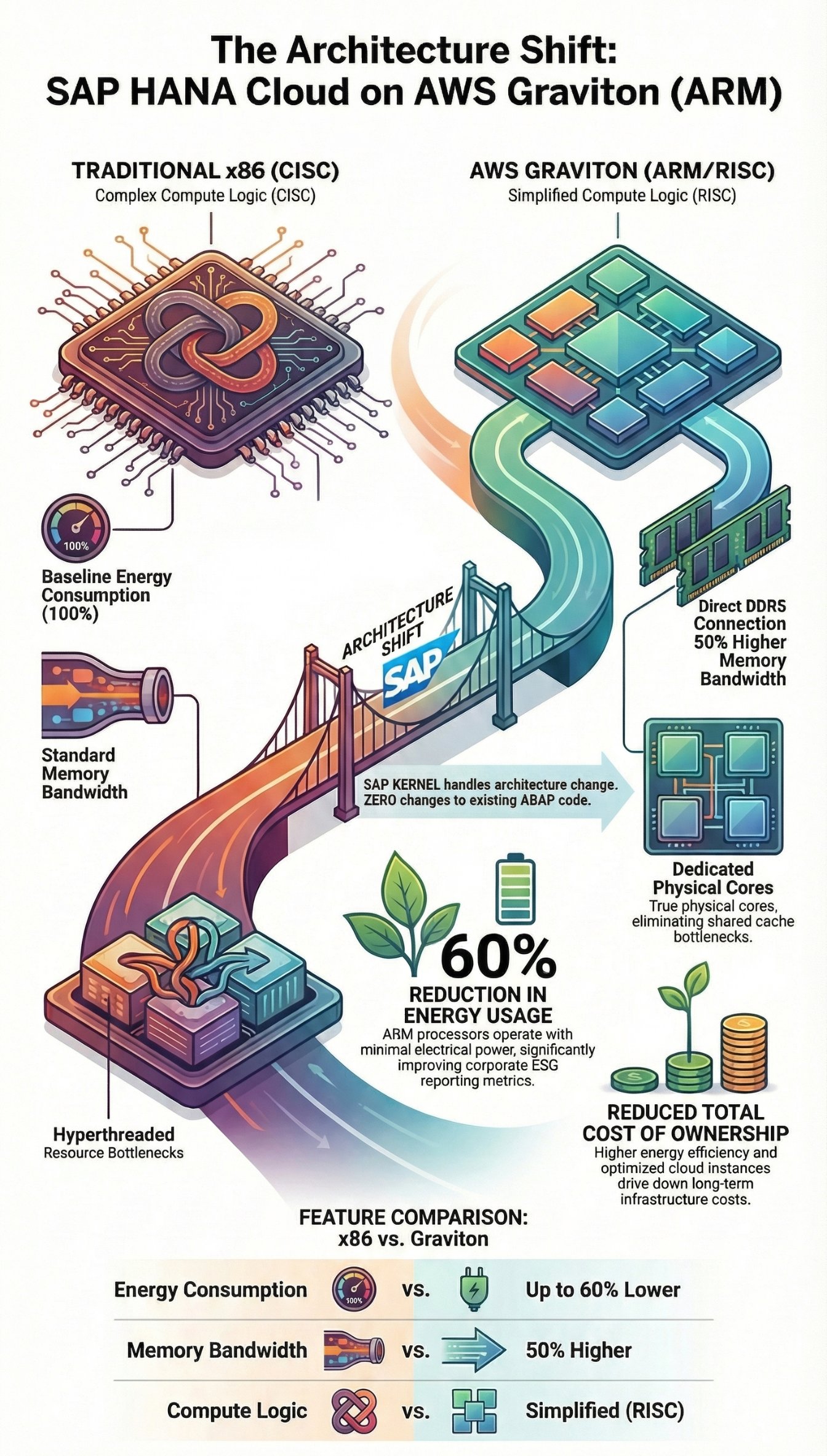
Classic x86 processors (Intel/AMD) use a CISC approach (Complex Instruction Set Computer). They have instruction sets that can execute highly complex operations in a single clock cycle. The price for this is a massive appetite for energy, enormous heat generation, and inefficient clock cycles during simple database operations.
AWS Graviton processors are based on the ARM architecture (Advanced RISC Machines). RISC stands for Reduced Instruction Set Computer. Here, the instructions are simple, uniform, and extremely fast to process. Every core of a Graviton processor is a true physical core (no hyperthreading). For SAP HANA, this means: There are no hidden latencies due to shared cache resources between virtual threads. The predictability of CPU cycles increases exponentially.
Memory Bandwidth: The Lifeblood of the HANA Column Store
An in-memory database like SAP HANA is rarely "CPU-bound" (limited by pure computing power), but almost always "Memory-bound". The bottleneck is the speed at which data can be pumped from RAM into the CPU caches (L1/L2/L3) when massively parallel Column Store scans are performed.
And this is exactly where the architecture of AWS Graviton3 and Graviton4 strikes mercilessly:
-
Graviton processors are directly connected to high-performance DDR5 memory.
-
They deliver up to 50% more memory bandwidth than comparable current-generation x86 instances.
-
For SAP HANA, this means: Table scans across billions of rows (e.g., in the
ACDOCA) are significantly accelerated, as the CPU cores no longer have to wait for data to be reloaded from the RAM.
ESG and Cost Efficiency: Up to 60% Less Energy Consumption
The driver for this architectural shift is not just pure performance, but the hard reality of data center costs and ESG (Environmental, Social, Governance) reporting.
Architecturally, ARM processors are trimmed to operate with minimal electrical power (which is why they are in every smartphone). An SAP landscape migrated to AWS Graviton consumes, on average, up to 60% less energy for the same or higher performance compared to x86.
In addition, AWS now offers "GROW with SAP" – the ERP cloud package for midmarket companies – directly via the AWS Marketplace. The underlying infrastructure relies heavily on these energy-efficient ARM instances, which massively drives down the Total Cost of Ownership (TCO).
The Impact on Custom Code (ABAP)
Do Basis administrators and developers now have to fear that their old Z-code will no longer run on ARM? The clear answer: No. SAP compiles the SAP kernel (the C/C++ foundation on which the NetWeaver/ABAP stack runs) natively for the ARM architecture. The ABAP code itself runs within the virtual ABAP machine. This abstraction layer completely intercepts the architecture change. Whether an Intel Xeon or an AWS Graviton is computing under the hood is completely transparent to the ABAP program (and the end-user in the Fiori Launchpad).
📢 SAP & AWS ARCHITECTURE NEWS TICKER (As of: October 2024) ━━━━━━━━━━━━━━━━━━━━━━━━━━━━━━━━━━━━━━━━━━━━━━━━━━━━━━━━━━━━━━━━ 🔹 AWS European Sovereign Cloud: AWS and SAP are deepening their partnership for the European market. SAP applications will be certified for the strictly sealed AWS European Sovereign Cloud. This guarantees absolute data sovereignty for critical infrastructure (KRITIS) customers and the public sector: Metadata and operations remain physically and administratively 100% within the EU. 🔹 Generative AI Hub meets Bedrock: SAP has completed the direct API integration of Amazon Bedrock into the SAP Generative AI Hub on the BTP. Architects can now use models like Anthropic Claude 3 directly in S/4HANA extensions (via CAP), protected by a secure PrivateLink connection.
Conclusion for Enterprise Architects
The use of ARM processors in the core SAP area was long considered a pipe dream. With the massive adoption of AWS Graviton chips for the SAP HANA Cloud in 2024, this future has become a reality.
For us Enterprise Architects, the sizing paradigm is changing: The stubborn fixation on clock speed and x86 cores is obsolete. Anyone designing a "Greenfield" cloud infrastructure today must evaluate Graviton. The combination of dedicated physical cores (without hyperthreading latencies), massive DDR5 memory bandwidth, and a drastic reduction in the carbon footprint makes the ARM architecture the new gold standard for cloud-native ERP systems.