Welcome back to the architectural drawing board! For years, there was an uncrossed red line in European architecture boards: "Our core ERP data and HR systems do not go into the public cloud." Especially for the critical infrastructure sector (KRITIS), banks, and public services, the US CLOUD Act and strict BSI C5 criteria were a massive blocker for the S/4HANA transformation.
In the fall of 2025, the tide has finally turned. AWS has spun up the AWS European Sovereign Cloud, and SAP has committed as a primary launch partner to host its enterprise workloads (RISE with SAP and BTP) there. Today we dissect what "Sovereign Cloud" really means architecturally – and why it is far more than just a new data center in Frankfurt.
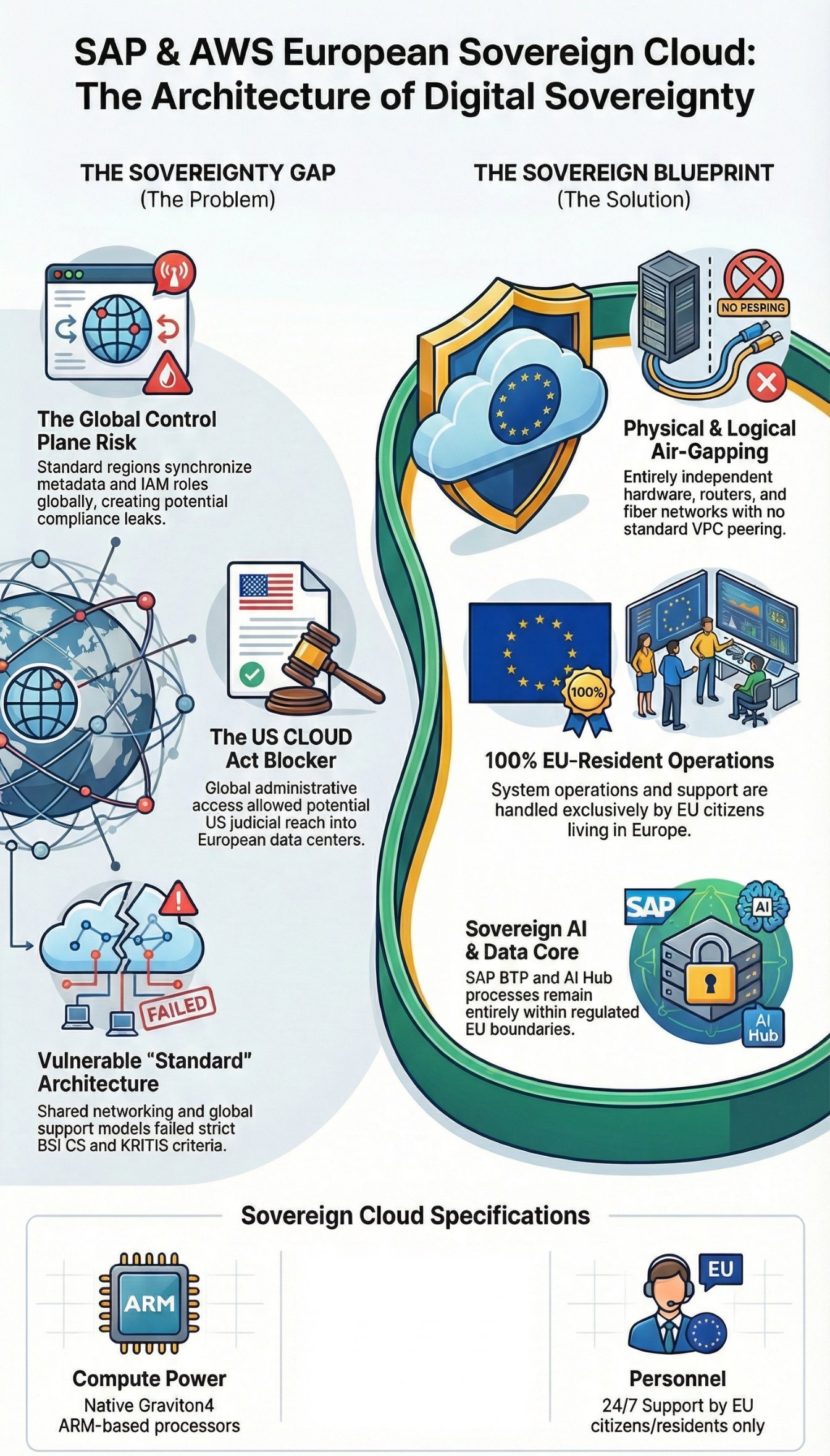
The Problem with Standard Regions
Until now, German SAP systems on AWS mostly ran in the eu-central-1 (Frankfurt) region. The physical data did not leave Germany, but the architectural problem lay in the Control Plane.
Metadata (who logs in when, IAM roles, billing data) was globally synchronized. In addition, administrators from the US (Follow-the-Sun support) could, in a theoretical extreme case – for instance, through a court order (CLOUD Act) – gain administrative access to the infrastructure.
For a defense contractor or a Ministry of Health, this residual risk was unacceptable for a "Lift & Shift" of the SAP landscape.
Deep Dive: The Architecture of the European Sovereign Cloud
The AWS European Sovereign Cloud is not a mere logical construct but a physically and logically completely isolated cloud infrastructure.
-
Hardware and Network Isolation: The Sovereign Cloud does not share fiber optic rings, routers, or data centers with regular AWS regions. It is a completely self-sufficient network.
-
Isolated Control Plane & Metadata: This is the most crucial architectural building block. AWS Identity and Access Management (IAM), billing systems, and resource management run exclusively within Europe. No metadata leaves the EU space.
-
Operations Exclusively by EU Citizens: At the OS and hypervisor level (AWS Nitro System), it is guaranteed that 24/7 operations and support are carried out exclusively by employees who are residents of the EU and EU citizens.
What Does This Mean for RISE with SAP?
SAP uses this isolated infrastructure to offer GROW with SAP and RISE with SAP (the S/4HANA Private Cloud Edition) to highly regulated customers.
For the Basis Administrator, nothing changes regarding the tools (like SAP Landscape Management or SWPM). But the compliance department can now prove at the code and infrastructure level that the shared responsibility model between SAP and AWS 100% safeguards European data sovereignty (Schrems II, GDPR).
SAP's own cloud-native services – such as the SAP BTP, the SAP Generative AI Hub, and SAP Datasphere – are built natively in these sovereign data centers, ensuring that even AI prompts (using RAG architectures) do not leave the strictly regulated EU area.
📢 SAP & AWS ARCHITECTURE NEWS TICKER (As of: September 2025) ━━━━━━━━━━━━━━━━━━━━━━━━━━━━━━━━━━━━━━━━━━━━━━━━━━━━━━━━━━━━━━━━ 🔹 Graviton4 in Sovereign Cloud: AWS confirms that the latest ARM-based Graviton4 processors are available directly at launch in the Sovereign Cloud for SAP workloads. Maximum data security thus meets the lowest energy consumption (ESG). 🔹 VPC Peering Restrictions: Architects beware! Direct VPC peering between a regular AWS region (e.g.,
eu-central-1) and the new Sovereign Cloud is architecturally (by design) not possible in order to guarantee the "Air-Gap". Interfaces must be modeled cleanly via approved, certified Transit Gateways or highly secure APIs.
Conclusion for Enterprise Architects
The launch of the AWS European Sovereign Cloud in 2025 tears down the last bastion of on-premise advocates. The argument "We cannot move to the public cloud due to data security" is now technically and legally invalidated.
For us Enterprise Architects, this means: The migration of government agencies, banks, and the defense sector to S/4HANA is now accelerating exponentially. The challenge of the coming years lies in designing hybrid architectures in such a way that non-critical workloads run in the cheaper, global cloud, while the S/4HANA crown jewels and the AI Core are strictly orchestrated in the Sovereign Cloud. Anyone who understands these architectural boundaries (Air-Gapping, IAM isolation) belongs to the absolute elite of SAP cloud architects.