- SAP BTP Deep Dive: The Ultimate PaaS Toolkit for Modern Enterprise Architecture
- The Baseline: Why a Cloud Platform is Inevitable
- The Business Case in Numbers (IDC Study Nov. 2022)
- What is the SAP BTP at its Core?
- The 5 Pillars of SAP BTP Architecture
- Architecture Strategy: Setup and Best Practices
- Evaluative Conclusion by the Architect
SAP BTP Deep Dive: The Ultimate PaaS Toolkit for Modern Enterprise Architecture
As a Senior IT Architect, I monitor the market very closely, and currently, there is hardly any avoiding one topic: the SAP Business Technology Platform (SAP BTP). Especially in the context of an upcoming S/4HANA migration, this platform is the essential link to keeping the "Digital Core" clean and outsourcing extensions. In this profound architecture blog, we will analyze the BTP in detail – from hard business cases to concrete service architecture to best practices for operations.
The Baseline: Why a Cloud Platform is Inevitable
Companies today face massive challenges. Labor shortages, demands for more sustainability, strict data privacy guidelines, and enormous global innovation pressure force IT to act. Digitalization is no longer a "nice-to-have" here, but an absolute no-brainer for competitiveness. We must drastically accelerate processes, automate repetitive manual tasks, and push the use of Artificial Intelligence to generate space for genuine creative power and innovation.
The Business Case in Numbers (IDC Study Nov. 2022)
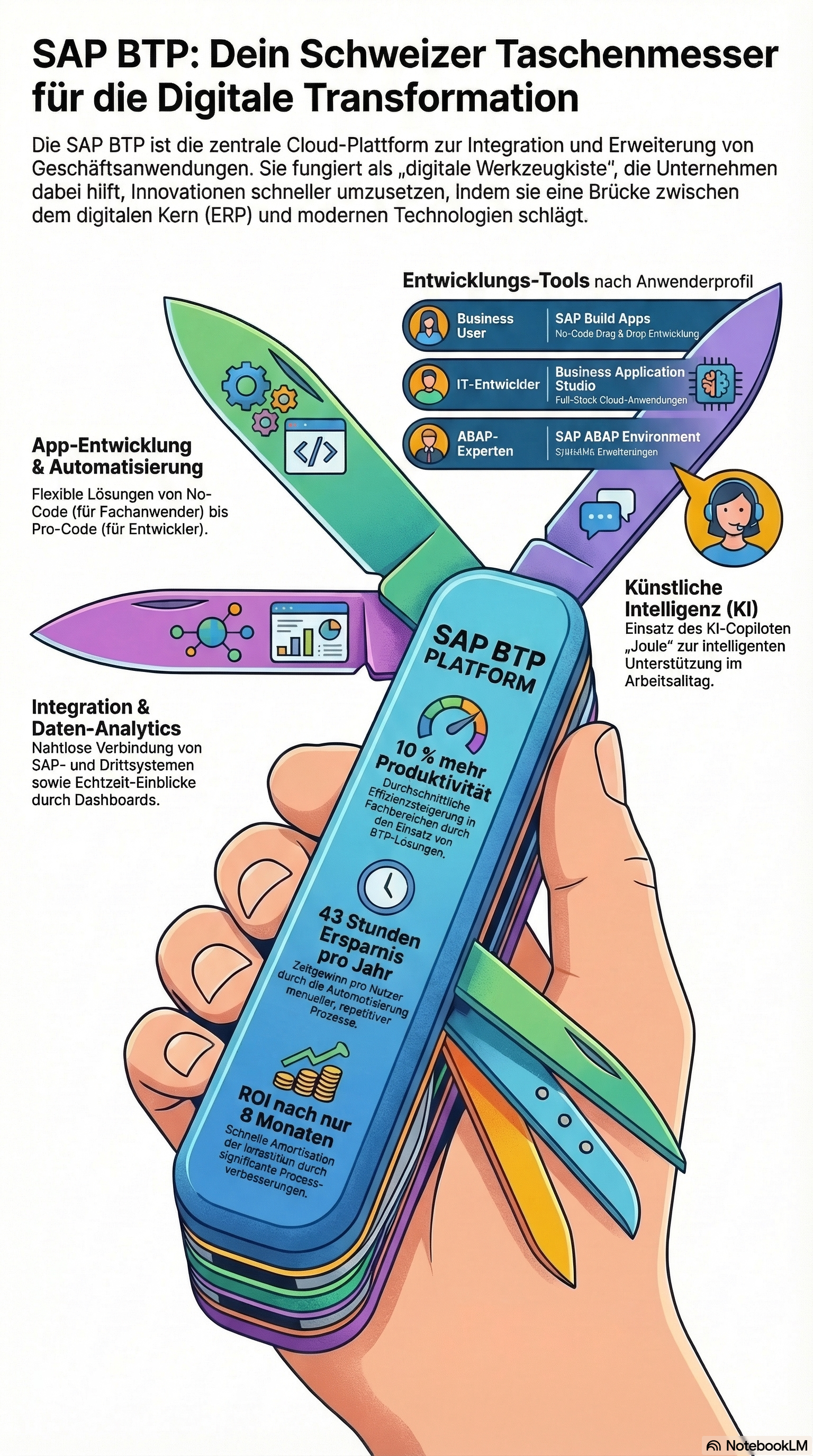
The SAP BTP is not just a technical playground; it delivers measurable financial results. A study by the US market research firm IDC (November 2022) has detailedly quantified the effects of S/4HANA in combination with the SAP BTP:
-
Productivity Increase: An average of 10% more productivity in business departments.
-
Time Savings through Automation: Saving 43 working hours per user per year through reduced error rates and automated workflows.
-
Significant Revenue Increase: Monetary advantage through reallocated, qualified personnel.
-
Return on Investment (ROI): The payback time for investing in the BTP is extremely short at an average of 8 months.
What is the SAP BTP at its Core?
The SAP BTP is a PaaS (Platform as a Service) offering and acts as SAP's central cloud, integration, and extension platform. It is best described as the "Swiss Army Knife" of IT architecture – a multifunctional ecosystem for industry-specific and generic functions. It allows you to develop and run business apps and integrate them seamlessly into both SAP and Non-SAP systems. The architecture rests on five central pillars.
The 5 Pillars of SAP BTP Architecture
Pillar 1: App Development (From No-Code to Pro-Code)
The platform addresses all target groups – from business users to hardcore developers.
-
SAP Build Apps (No-Code/Low-Code): A drag-and-drop editor for so-called Citizen Developers. Business users without programming knowledge can create web applications and mobile apps here. Pre-configured components and connectors massively facilitate backend integration.
-
SAP Build Code: A service that works hand-in-hand with Build Apps.
-
SAP Business Application Studio (Pro-Code): The primary cloud development environment, architecturally aligned with popular IDEs like Eclipse or Visual Studio. Full-stack scenarios and Fiori apps are developed here via Cloud Foundry. It supports common technologies like Java and JavaScript and is deeply integrated with SAP HANA Cloud and the HANA Database Explorer.
-
SAP ABAP Environment: A highly specialized development environment for ABAP developers. Perfect for backend development and specific adaptations aimed directly at integration into S/4HANA.
-
Operations & Deployment: Cloud Transport Management is used for deployment across different system landscapes. Secure operations are ensured by the Identity Authentication Service (user management) and Cloud Logging (monitoring).
Pillar 2: Process Automation
With SAP Build Process Automation, workflows and approval processes can be mapped entirely without code (Zero Code). Architectural Structure of Workflows:
-
Triggers: Every process starts with a trigger (e.g., an API or a user form).
-
Logic Components: In the visual editor, conditions (If/Else loops), decisions, and approvals can be orchestrated via drag-and-drop.
-
Intelligence: Integrated AI features assist with data extraction (e.g., copy/pasting from documents).
Pillar 3: Integration (The Nervous System of IT)
The BTP offers two primary tools for unifying hybrid system landscapes:
-
Cloud Connector: The out-of-the-box solution for secure, robust connection of local on-premise systems to BTP services. It supports numerous protocols and establishes a secure tunnel.
-
SAP Integration Suite: The comprehensive middleware for complex, hybrid cloud landscapes. It connects SAP and Non-SAP systems, manages APIs, and offers pre-built connectors for B2B, B2C, and B2G scenarios.
Pillar 4: Data and Analytics
Data is the gold of architecture. The BTP provides three high-performance core solutions here:
-
SAP Datasphere: An integrated, unified data layer across diverse (SAP and Non-SAP) data landscapes. It handles data integration, cataloging, and modeling to ensure the highest data quality.
-
SAP HANA Cloud: The heart of intelligent real-time data applications.
-
SAP Analytics Cloud: The front-end solution for analytics and enterprise planning. It includes:
-
Business Analytics: Collecting and interpreting data.
-
Augmented Analytics: Data analysis incorporating machine learning.
-
Predictive Analytics: Forecasting future events based on historical data.
Pillar 5: Artificial Intelligence
SAP approaches the topic of AI on three different levels:
-
AI Foundation: An "All-in-One AI Toolkit" providing developers with customizable AI models that can be trained on business data.
-
Embedded AI: Direct integration of AI capabilities into existing SAP business applications for faster workflows.
-
Joule: SAP's AI copilot. A powerful chatbot in the SAP system that understands business context and assists the user in gathering information and executing tasks.
Architecture Strategy: Setup and Best Practices
To successfully roll out the SAP BTP in an enterprise environment, fundamental architectural decisions must be made early on.
Decision Matrix: Low-Code vs. Pro-Code
When to use what?
-
Low-Code/No-Code Advantages: Extreme speed to go-live, high accessibility for business developers, cost efficiency. Ideal for simple to moderately complex projects.
-
Pro-Code Indicators: As soon as bespoke, highly complex, time-critical custom software is involved, you rely on experienced developers (Pro-Code). In reality, we mostly see a hybrid mix of both.
Checklist: Strategic Onboarding into SAP BTP
Those who simply "dive in" will face massive refactoring costs later. Stick to these steps:
-
[ ] Needs Analysis & Strategy: Define goals and use cases upfront.
-
[ ] Resource Planning: Utilize the SAP Discovery Center to identify required services and for precise pricing indications.
-
[ ] Structure Setup (Critical!): Before activating the first service, the hierarchy must imperatively be set up cleanly. This concerns the creation of Global Accounts, Subaccounts, and Spaces. Reversing this structure later involves extreme effort!
-
[ ] Process Understanding for Automations: First thoroughly understand the business process, then start with a small process. Imperatively use pre-built templates from the SAP Store as inspiration.
-
[ ] Verify Scalability: Design processes incrementally, test intensively, and build the architecture to withstand large volumes.
Evaluative Conclusion by the Architect
The SAP BTP is far more than a mere marketing term; it is the foundational bedrock of a future-proof SAP landscape. Designed as a "digital playground," it cleanly separates custom developments from the EAP (Enterprise Application Programming) backend (Clean Core approach). The development in user-friendliness in recent years is particularly impressive, especially through tools like SAP Build Apps. The hard financial metrics (ROI in 8 months, 43 hours saved per capita) justify the initial platform investment to C-level executives effortlessly. For us architects, this means: The BTP is a given. The art now lies in carving the account model (Global Accounts/Subaccounts) cleanly during initial setup and intelligently weighing No-Code acceleration against Pro-Code quality. Whoever walks this hybrid path creates an IT landscape that responds not just reactively, but proactively to global innovation pressure.