The world of Enterprise IT, and particularly SAP architectures, is in the midst of a tectonic shift. Gone are the days of monolithic ERP giants where modifications were anchored deep in proprietary source code, inevitably leading to massive technical debt and endless update cycles. From my perspective as an Enterprise Architect, the SAP Business Technology Platform (BTP) is not simply a new product, but the technological foundation for future-proof, decoupled system landscapes. BTP precisely addresses the accumulated pains of distributed data silos and cumbersome ERP cores. In this detailed architecture analysis, we combine historically grown foundational knowledge with the latest developments surrounding the BTP, the SAP Integration Suite, and the inevitable migration from legacy systems like SAP PI/PO.
- The Architectural Foundation: SAP BTP as an Open Multi-Cloud Base
- Structure and Runtime Environments
- The Clean Core Paradigm: Paradigm Shift in Extensibility
- SAP Integration Suite: The New Heart of Enterprise Architecture
- The Burning Platform: Migration from SAP PI/PO to Integration Suite
- DevOps, Security & Governance in the Cloud
- Conclusion
The Architectural Foundation: SAP BTP as an Open Multi-Cloud Base
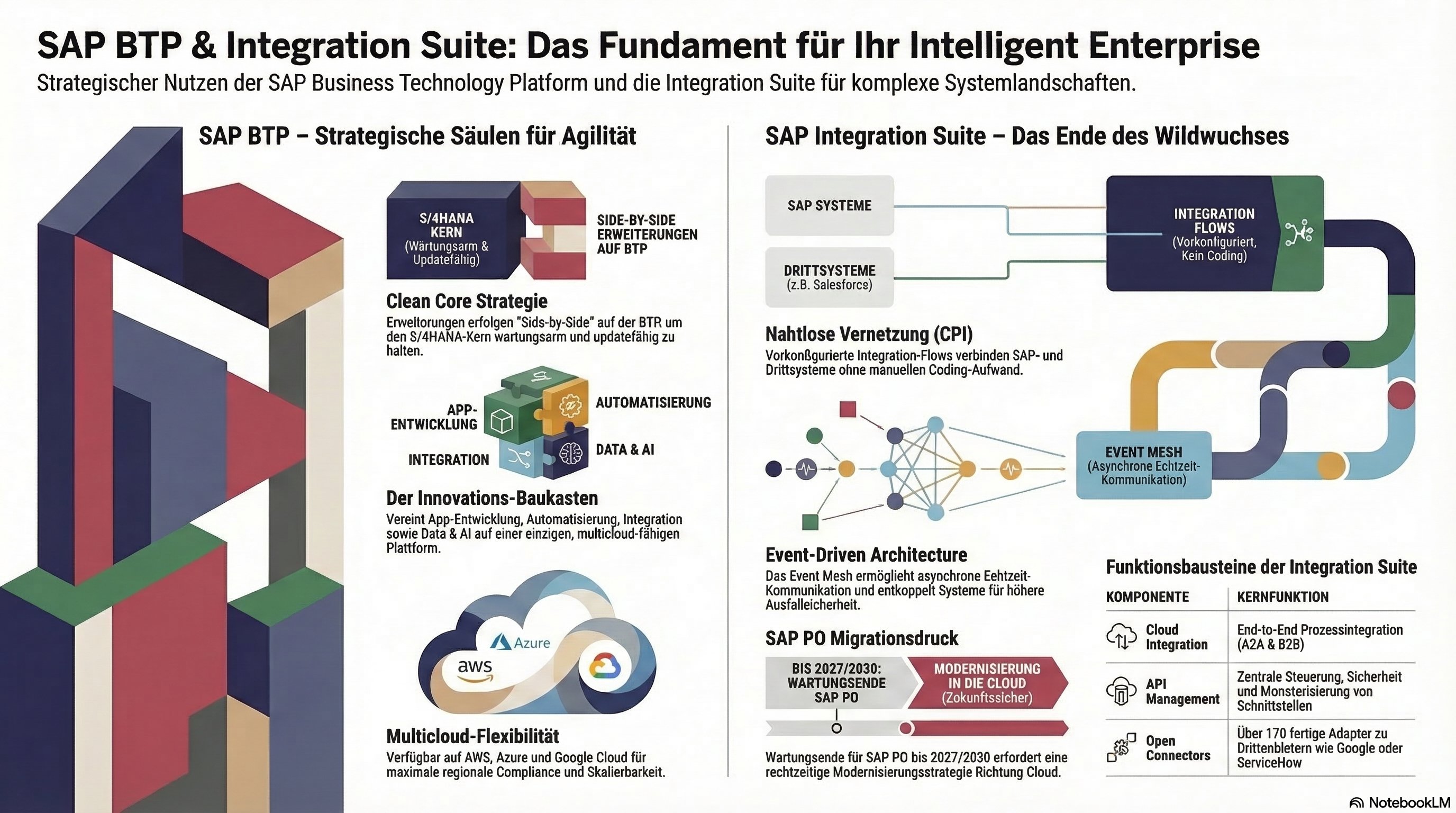
The SAP BTP operates as a classic Platform-as-a-Service (PaaS) and acts as a bridge between existing on-premise systems and state-of-the-art cloud technologies. To break dependency on a single provider, the platform is designed as a multi-cloud architecture. It can be seamlessly deployed on the infrastructures of major hyperscalers such as AWS, Microsoft Azure, Google Cloud, and Alibaba Cloud. This provides us architects the flexibility to precisely navigate regulatory compliance requirements or regional conditions (e.g., data centers in Frankfurt).
Structure and Runtime Environments
On an administrative level, the BTP relies on a strict account model. Below a master contract exists the Global Account, which is subdivided into various Subaccounts. Best architectural practices demand strict tenant separation here – be it by Development, Test, and Production environments (two- or three-tier) or by specific Lines of Business (LoB). Technologically, the BTP offers three primary runtime environments for developing custom extensions (Side-by-Side Extensibility):
-
Cloud Foundry Environment: The de facto standard for polyglot microservices. Applications can be run here in languages like Node.js, Java, or within the SAP-specific UI5 framework.
-
Kyma / Kubernetes Environment: For highly scalable, containerized microservices requiring the full orchestration power of Kubernetes.
-
ABAP Environment ("Steampunk"): A revolutionary innovation for traditional SAP development teams. It represents a controlled "ABAP Light version" directly in the cloud, allowing ABAP-based extensions to be built without contaminating the ERP core. These runtimes are supplemented by a multitude of managed services, including databases like SAP HANA Cloud, analytics solutions (SAP Analytics Cloud, SAP Datasphere, Business Data Cloud), and IAM components (Cloud Identity Services) that couple seamlessly via Single Sign-On to corporate identity providers like Microsoft Entra ID or Okta. An important shift for developers: The old SAP Web IDE (Neo environment), whose support expires in 2027, is being replaced by the SAP Business Application Studio (BAS) on Cloud Foundry. Alternatively, SAP is positioning the new SAP Build Code, which enriches BAS with powerful AI features for code generation.
The Clean Core Paradigm: Paradigm Shift in Extensibility
The historical flaw of many SAP implementations was the direct modification of ERP standard code (Customizing and User Exits). This led to extremely high costs during upgrades. The BTP is the enabler of the Clean Core strategy. Any custom code moves out of the digital core (SAP S/4HANA or ECC) and onto the BTP. A technical example: Instead of programming a highly complex calculation algorithm deep inside S/4HANA, it is realized as an independent microservice on the BTP. S/4HANA calls this service synchronously via OData API or asynchronously via events. The ERP system remains completely standard, is upgradable at any time, and the IT landscape gains massive agility.
SAP Integration Suite: The New Heart of Enterprise Architecture
Historically, many companies suffered from massive "integration sprawl" – an uncontrollable amount of point-to-point connections, a lack of governance, and an extremely error-prone, heterogeneous middleware landscape. The SAP Integration Suite, a comprehensive Integration Platform as a Service (iPaaS), is SAP's strategic answer to this chaos. It unites modular toolkits covering all facets of modern integration typologies (A2A, B2B, B2G, Ground-to-Cloud). Let's take a deep look at the architecture components:
1. Cloud Integration (formerly CPI) The technical core of the Suite. Business processes crossing system boundaries are modeled here using so-called Integration Flows (iFlows). Developers utilize a graphical modeling environment for routing, mapping, and converting payloads. The adapter variety is enormous, ranging from classic protocols like HTTP, SFTP, and JDBC to established SAP formats (IDoc) and the modern OData standard. Thousands of pre-built Integration Packs in the SAP API Business Hub drastically reduce time-to-market.
2. SAP API Management Anyone building microservices must manage APIs. API Management acts as a central portal to securely expose existing SAP and Non-SAP backends as API proxies. The focus here is on security and traffic governance. Developers can version the API lifecycle and apply over 40 predefined policies, for instance for authorization (OAuth 2.0, SAML), rate limiting (protection against DDoS spikes), or caching. Even the monetization of API calls is natively integrated.
3. Event Mesh (Event-Driven Architecture) This is perhaps architecturally the most exciting building block. Instead of relying on rigid, synchronous point-to-point calls (which can lead to system failure during peak loads), Event Mesh implements an asynchronous Event-Driven Architecture (EDA). For example, an SAP S/4HANA publishes the event "Order Created". The Event Mesh acts as an event broker network, buffers the message, and distributes it in real-time to subscribed third-party systems (e.g., Salesforce, Data Lakes). This radically decouples systems, increases resilience, and absorbs peak loads in the millisecond range.
4. Integration Advisor & Open Connectors The Integration Advisor uses machine learning and the "swarm intelligence" of global SAP projects (crowdsourcing) to highly automate complex B2B mappings like EDIFACT. Open Connectors, in turn, provide over 170 pre-built adapters to third-party vendors (ServiceNow, Salesforce, Google Workspace), standardizing and abstracting target system API specifics and rendering custom code obsolete.
5. Edge Integration Cell For hybrid scenarios where Ground-to-Ground or On-Premise integrations must not leave the corporate network for compliance reasons, the Edge Integration Cell offers a runtime running on a local Kubernetes cluster.
The Burning Platform: Migration from SAP PI/PO to Integration Suite
For all Basis Architects, the clock is ticking: The classic middleware SAP Process Integration / Process Orchestration (PI/PO) drops out of standard maintenance in 2027, with an optional (and expensive) Extended Support up to 2030 maximum. Simply sitting it out is not an option. Migration requires strategic excellence and traditionally breaks down into four phases:
-
Assessment & Analysis: Understanding the existing landscape is often the biggest stumbling block, as historical interfaces are frequently poorly documented (reverse engineering required). Utilizing the SAP Migration Assessment Tool is mandatory to scan the current state of the PI/PO landscape and weed out unused legacy baggage.
-
Architecture Design & Roadmap: A grave mistake is attempting a 1:1 Lift-and-Shift. The migration must be used to transfer old patterns into modern concepts (e.g., Event Mesh or Open Connectors) (Redesign). Iterative parallel operation of both worlds is essential.
-
Migration & Refactoring: Although the Cloud Integration Content Migration Tool can automatically convert mappings and parts of flows, manual rework is indispensable for highly customized interfaces. In particular, complex adapter modules, Java mappings, or User Defined Functions (UDFs) from PO times often cannot be transferred directly and must be rewritten in the BTP using Groovy Scripts, for example.
-
Testing & Go-Live: Integrations are the nervous system of IT. Multi-stage testing cycles (possibly automated) and an initial pilot migration of less critical interfaces are strictly necessary. A strict hypercare phase must be scheduled after Go-Live.
DevOps, Security & Governance in the Cloud
Technology alone solves no organizational problems. Without governance, the BTP threatens to suffer the same sprawl as previous on-premise setups. Best practices demand "Governance First".
-
Center of Excellence (CoE): It is essential to build an interdisciplinary team that defines architecture guidelines, naming conventions (for Services and Spaces), and clear onboarding processes.
-
Security by Design: Fine-grained role concepts, strict authentication (OAuth 2.0, SAML, Certificates), and isolated network access via the SAP Cloud Connector must be established before the first flow deployment.
-
DevOps & CI/CD: Integration artifacts like iFlows must be treated like traditional software code. The BTP provides the SAP CI/CD Service and Cloud Transport Management Service to deploy changes controlled from Dev to Prod environments. This is flanked by in-depth monitoring using SAP Cloud ALM.
-
FinOps: Since BTP is billed on usage-based models (Subscription or Cloud Credits), budgets and quotas must be monitored to avoid cost explosions during scaling.
Conclusion
The SAP Business Technology Platform and its most powerful component, the SAP Integration Suite, mark the final intersection between monolithic legacy IT and modern, highly flexible cloud architecture. The "old basic knowledge" from the days of ABAP modifications and rigid PI/PO landscapes does not become obsolete, but must be transferred: from an on-premise mindset to a modular, API- and event-driven mindset. The 2027/2030 deadline for PI/PO is not merely a threat, but the desperately needed catalyst to radically clean up the IT landscape. Those who implement the BTP according to the principles of Clean Core, strong governance, and an agile DevOps approach gain not only a highly available scaling foundation. They equip their enterprise with the innovation engine necessary to map AI services, predictive data analytics, and seamless B2B/A2A processes performantly, securely, and future-proof. It is time to evolve from managing legacy burdens to becoming the architect of the future. Start small, utilize Free Tier models for pilot use cases, and orchestrate the transformation jointly with Business and IT.