The end of support for classic SAP ERP is inexorably approaching, and for most companies, there is no way around a transformation. As a Senior SAP Technology Consultant, I see daily how organizations struggle with the decision to leave old paths and venture into the world of SAP S/4HANA. This is by no means just a simple release upgrade, but a fundamental paradigm shift in system architecture, data modeling, and user interface. In this deep dive, we will analyze the technical discrepancies, architectural data, and strategic implications down to the smallest detail.
- Definition of Terms: From Classic SAP ECC to the Intelligent Suite
- Quantum Leap in System Architecture: The In-Memory Revolution
- The Data Model: "Single Source of Truth" through the Universal Journal
- Architecture of Business Processes: "Lines of Business" Instead of Rigid Modules
- User Interface: The End of the Classic SAP GUI
- Technological Constants and Native AI Integration
- Critical Analysis: Pros and Cons of the Migration
- Strategic Blueprint: 3 Tips for a Clean Migration
- Conclusion
Definition of Terms: From Classic SAP ECC to the Intelligent Suite
To understand the technological evolution, we must sharpen our terminology. SAP ERP (Enterprise Resource Planning) often serves as an umbrella term but is mostly used synonymously in practice for SAP ECC (SAP ERP Central Component). As the direct successor to the legendary SAP R/3, ECC forms the modular core of the previous SAP Business Suite, which holistically integrates core processes such as finance, controlling, materials management, sales, and human resources.
SAP S/4HANA, on the other hand, stands for "Suite for HANA" and is the current, fourth ERP generation of the software giant from Walldorf. The central difference lies in its orientation: S/4HANA was designed as a native enabler for digital transformation and offers highly flexible deployment options. Companies have the choice between on-premise installations on their own servers, the S/4HANA Cloud (Software-as-a-Service), or hybrid landscapes. SAP strategically focuses heavily on cloud delivery to ensure maximum scalability.
Quantum Leap in System Architecture: The In-Memory Revolution
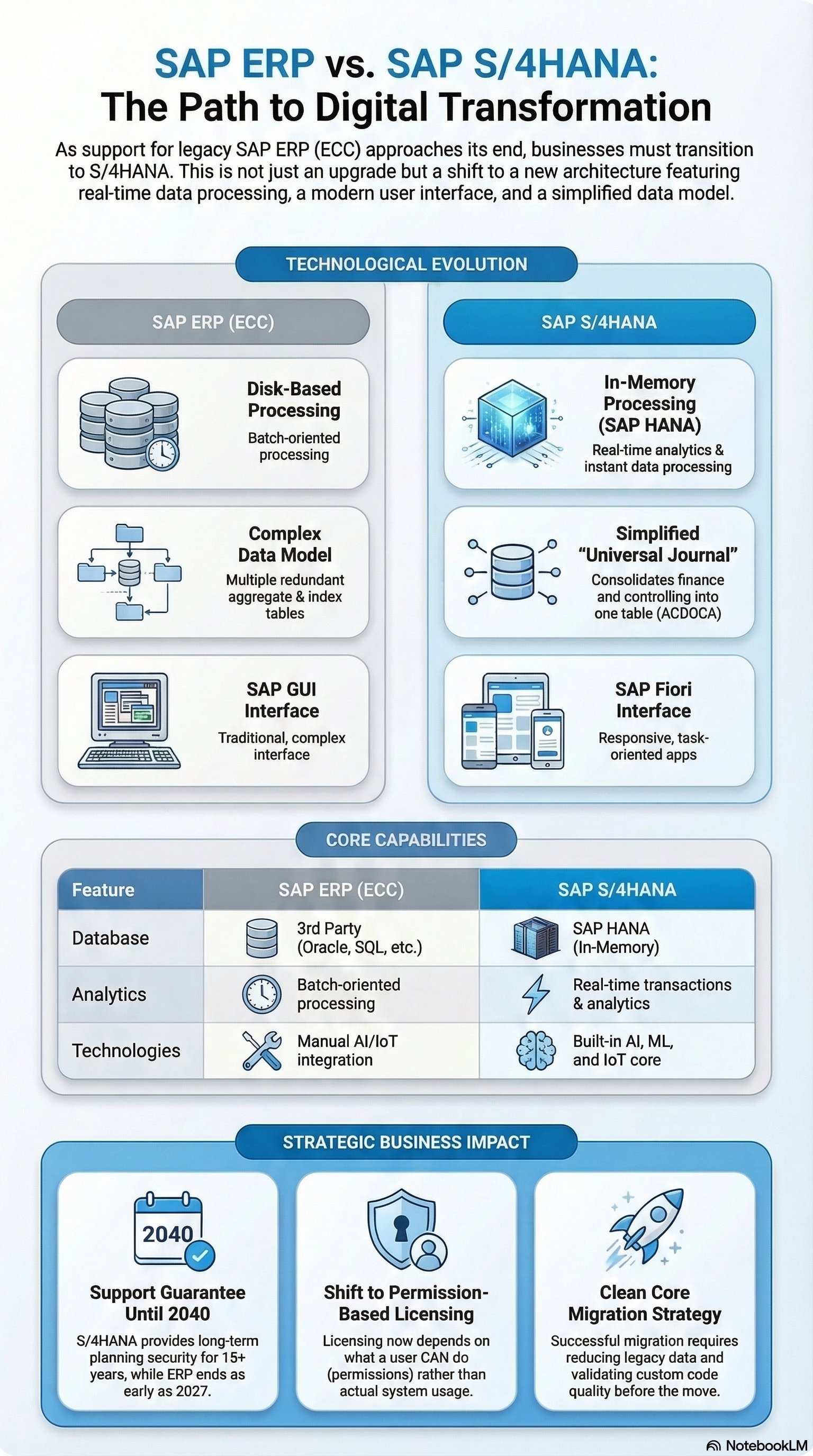
The most severe technological difference lies in the persistence layer. Classic SAP ERP operates database-agnostically and supports row-based, relational databases from third-party providers such as Oracle, DB2, SQL Server, or MaxDB.
With S/4HANA, SAP forces the switch to the proprietary SAP HANA technology. HANA is an all-in-one in-memory database that primarily keeps data in the main memory (RAM) and enables both column- and row-oriented data access (Column & Row Store). While a classic ECC system can also be operated on a HANA database (known as "Suite on HANA"), only S/4HANA exploits the full potential of the technology through newly developed CDS Views (Core Data Services) and drastically simplified access tracts.
The results are breathtaking real-time analytics. The strict separation of transactional systems (OLTP) and analytical systems (OLAP) is eliminated. Through Embedded Analytics, sales representatives, controllers, and production managers can now access real-time data on project costs, inventory levels, and machine data without time-consuming batch runs.
The Data Model: "Single Source of Truth" through the Universal Journal
Under the hood of SAP ERP, we find a highly redundant structure of countless aggregate tables and index tables, where Finance (FI) and Controlling (CO) are strictly separated.
SAP S/4HANA eliminates these redundancies and introduces the principle of the "Single Source of Truth". The centerpiece of this consolidation is the Universal Journal (Table ACDOCA). FI and CO data merge in this massive, central table. This architectural masterpiece drastically reduces the number of technical objects: compared to SAP ERP 6.0, S/4HANA requires less than half the tables and lines of code. This not only dramatically lowers storage requirements but also significantly reduces IT maintenance costs.
Additionally, the master data model changes: the historically separated customer and vendor masters are replaced by the mandatory Business Partner concept (Single Point of Truth).
Architecture of Business Processes: "Lines of Business" Instead of Rigid Modules
The days of classic, rigid modules (FI, CO, MM, SD, PP, HCM) are over in the S/4HANA world. SAP now speaks of process-oriented "Lines of Business" (LoB), which map real end-to-end business workflows.
For example, classic Materials Management (MM) becomes "Sourcing and Procurement", which allows a much closer integration of procurement and supply chain management. Another architectural milestone: Customer Relationship Management (CRM), formerly a separate system with its own database and middleware, is now directly integrated into the core of S/4HANA.
SAP's vision goes even further: via the Business Technology Platform (BTP), the LoB principle is to be further developed into a Business-Process-as-a-Service (BPaaS), where customers no longer book monolithic modules but consume fine-grained sub-processes.
User Interface: The End of the Classic SAP GUI
The "S" in S/4HANA stands for "simple" – and this is particularly evident in the frontend. The aging SAP GUI is being replaced as the standard interface by SAP Fiori. Fiori offers a modern, responsive User Experience (UX) that uses reduced-complexity, role-based apps instead of monolithic transaction codes. The central entry point is the Fiori Launchpad, which is highly customizable to the respective user and strongly reminiscent of the UX of modern smartphone operating systems.
Technological Constants and Native AI Integration
Despite this profound transformation, SAP does not throw everything overboard. Important technological pillars remain: ABAP remains the primary language for in-house developments (increasingly driven in the future by the SAP RAP – RESTful Application Programming Model). The authorization concept via PFCG roles, IDocs for asynchronous interfaces, and RFC (Remote Function Call) for system communication also remain elementary components.
What is completely new, however, is the deep integration of future technologies. While in classic ERP, Artificial Intelligence (AI), Machine Learning (ML), or IoT often had to be laboriously retrofitted via Add-Ons or Enhancement Packages, these are natively integrated into the core in S/4HANA. Built-in ML algorithms analyze mass data completely autonomously, and the AI assistant Joule enables control via voice commands.
Critical Analysis: Pros and Cons of the Migration
The 4 Massive Advantages of S/4HANA
-
Planning Security: Maintenance for SAP ERP ends in 2027 (or 2030 for Extended Maintenance, or 2033 for "RISE with SAP" customers). For S/4HANA, SAP guarantees support until 2040 – half an eternity in the IT world.
-
Best Practices: Pre-defined standard processes can be activated directly via the SAP Process Navigator, which drastically shortens implementation times.
-
Cost and Structure Reduction: The Universal Journal (ACDOCA) and the elimination of aggregate tables streamline the system, lower storage requirements, and reduce maintenance efforts.
-
Future-Proofing: Embedded Machine Learning and AI out-of-the-box ready the system for autonomous enterprise control.
The 3 Underestimated Disadvantages and Risks
-
The New Licensing Model: A notorious cost factor! Previously, licenses were based on actual user behavior. S/4HANA licenses according to assigned authorizations. If old PFCG roles are migrated 1:1 without reflection, companies pay for theoretical rights, which regularly leads to a "cost shock".
-
Archivierungs-Schnittstellen (ArchiveLink vs. CMIS): The proven ArchiveLink interface, the gold standard for document storage for 30 years, is to be replaced by CMIS (Content Management Interoperability Services). CMIS often only rudimentarily maps complex scenarios such as late barcode filing or deep SAP Business Workflow integrations. Process disruptions loom here.
-
Maturity of New Functions: While ERP functions have been field-tested for decades, some young S/4HANA services still have teething problems, which slightly increases the implementation risk.
Strategic Blueprint: 3 Tips for a Clean Migration
From a consultant's perspective, the transition requires extremely precise preparatory work:
-
Reduce Data: Lean HANA databases save an enormous amount of money. Before migrating, old business transactions must be closed and outsourced to external archives.
-
Revolutionize Form Management (Adobe Forms): S/4HANA delivers best-practice business services directly with Adobe Forms. Old technologies like SAPscript or Smartforms must give way. If form management fails, the go-live fails – plan massive project time for this!
-
Source Code Analysis (Custom Code): The quality of the existing Z-code dictates your roadmap. Automated check tools must ruthlessly identify legacy issues in the ABAP code (e.g., native SQL statements that no longer work on HANA).
Conclusion
The step from SAP ERP to SAP S/4HANA is not a trivial IT upgrade, but a far-reaching strategic shift to a completely new technological platform. On one side stands the rock-solid, decades-matured stability of SAP ECC; on the other, the breathtaking performance of in-memory processing, the radically simplified data model of the Universal Journal, and the modern Fiori UX.
Those who thoroughly grasp these architectural differences in advance, rebuild the role and licensing concept, and modernize form management master not only a technical necessity but transform their ERP landscape into a genuine, data-driven market advantage. The clock is ticking until 2027 – the time for monolithic silo architectures has officially run out.