Welcome, tech enthusiasts and architecture colleagues! Anyone wanting to survive in today's SAP world cannot be satisfied with mere buzzwords. The transition from the classic SAP Business Suite (SAP ECC 6.0) to SAP S/4HANA is not just an upgrade; it is a fundamental paradigm shift at the database and application levels. Today, we are taking the architecture apart and profoundly analyzing the evolution from the groundbreaking version 1511 to the highly integrated release 2022.
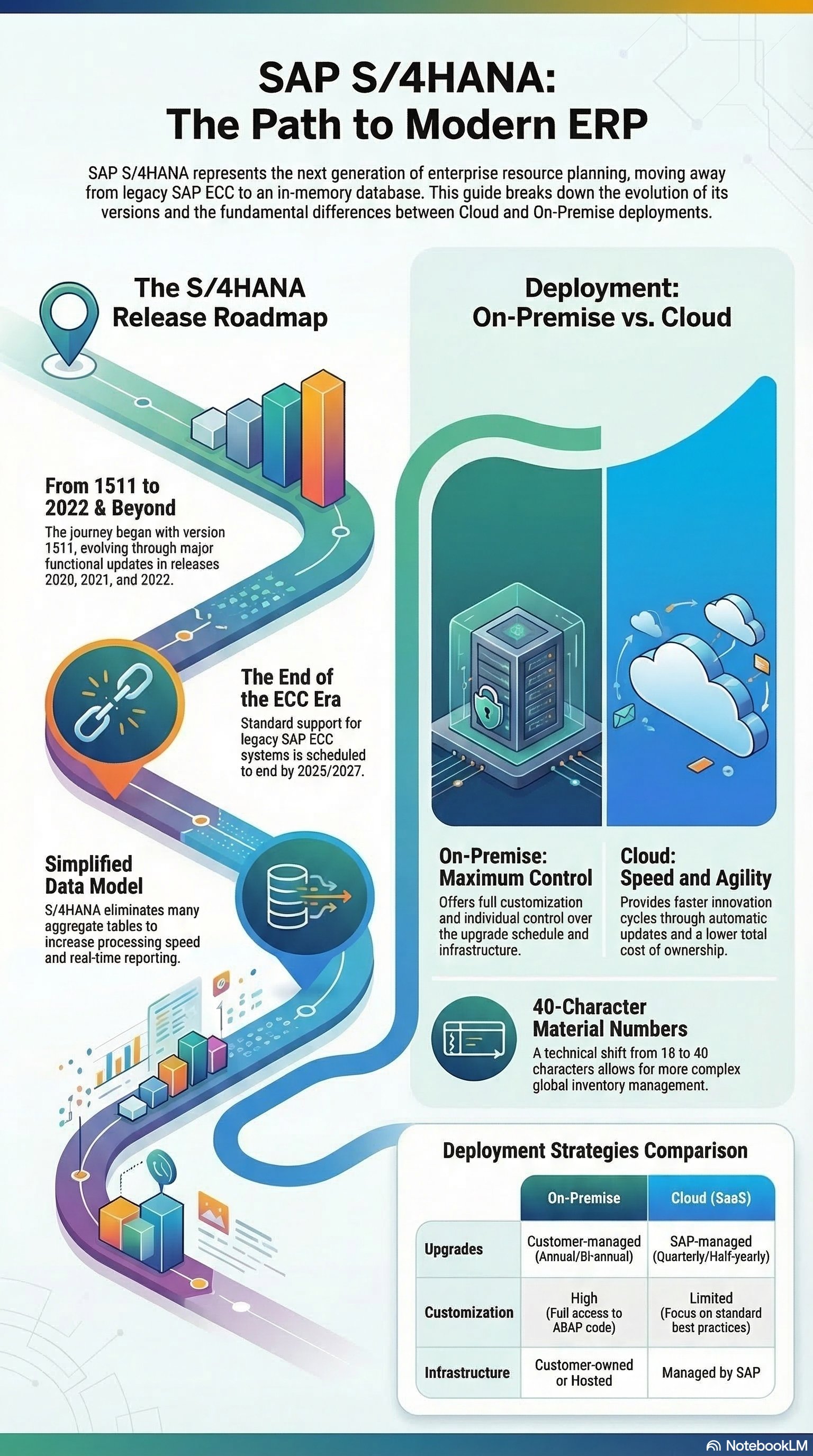
The Fundamental Architecture Shift: The "Principle of One"
Before diving into versioning, we must examine the architectural foundation underlying all S/4HANA releases. The HANA In-Memory Database enabled the elimination of aggregate and index tables.
Two absolute gamechangers in the architecture:
-
The Universal Journal (Table ACDOCA): In finance, FI (Financial Accounting) and CO (Controlling) were merged at the table level. Historical tables like
BSIS,BSAS,COEP,FAGLFLEXA, orANEPare obsolete as physical tables and were replaced by HANA Core Data Services (CDS) Views (so-called Compatibility Views). This means: No more batch reconciliation between general and sub-ledgers, but a true Single Source of Truth approach. -
The Material Number Extension (MATNR): A massive break from the ECC past. The
MATNRdomain was expanded from 18 to 40 characters. Developers must be extremely careful with custom code, as Z-tables and BAPIs using hard lengths ofCHAR(18)will inevitably throw dumps or truncation errors. TransactionAMILallows the configuration of this extension, but the code must be validated using the Code Inspector (SCI) or ATC (ABAP Test Cockpit) with S/4HANA Readiness Checks.
Data extraction for SAP BW has also changed massively: The classic Service-API (S-API) extractors of the Business Suite are gradually being replaced by ABAP CDS Views. Modern extraction runs via the ODP framework (Operational Data Provisioning), where the CDS View must be annotated with @Analytics.dataExtraction.enabled: true. This enables delta extractions (Change Data Capture) directly at the database level without redundant setup tables.
The Evolution Stages: From 1511 to 2022
The nomenclature of SAP S/4HANA has changed over the years. The early on-premise releases followed the YYMM schema (e.g., 1511 for November 2015), before SAP pivoted to the year format YYYY with release 2020.
SAP S/4HANA 1511: The Big Bang of Logistics
After S/4HANA Finance (formerly Simple Finance) already existed, Release 1511 (and the crucial Feature Pack 01) brought the restructuring of logistics (S/4HANA Enterprise Management).
-
Architecture Update: Introduction of Table MATDOC, which replaced the historically fragmented tables
MKPF(Header) andMSEG(Items) for material documents. TheINSERTthroughput for material postings increased tenfold thanks to this flat architecture. -
Business Partner (BP): The transactions
XD01(Customer) andVD01(Vendor) were rigorously replaced by the central Business Partner (Transaction BP). Without CVI (Customer-Vendor-Integration), a migration to 1511 (and subsequent releases) is technically impossible.
The Bridge Releases: 1610 to 1909 (Embedded Era)
Between 2016 and 2019, SAP focused on the Co-Deployment Strategy. Standalone systems like SAP EWM (Extended Warehouse Management) and SAP TM (Transportation Management) were integrated directly into the S/4 core as Embedded EWM/TM. This meant the elimination of Core Interface (CIF) connections for master and transactional data, drastically simplifying the system landscape. From 1709 onwards, HANA 2.0 also became a mandatory prerequisite.
SAP S/4HANA 2020: The Maturity Release
With version 2020 (and Feature Pack WN_OP2020_DE), SAP said goodbye to the old naming scheme and delivered massive architecture improvements.
-
Advanced Financial Closing (AFC): Seamless integration of RPA (Robotic Process Automation) directly into the closing cockpits.
-
Fiori 3.0 Spaces & Pages: The classic tile homepage was replaced by a more complex, space- and role-based UI concept, drastically improving user experience and loading times (based on the OData V4 protocol).
SAP S/4HANA 2021: Deep SD Integration and MRP Optimization
Release 2021 placed a strong focus on the Sales & Distribution (SD) module as well as Material Requirements Planning.
-
Mass Change Capabilities in SD: Users could now perform massive field changes (e.g., routes or pricing conditions) across hundreds of sales orders directly via Fiori apps, without having to resort to the error-prone transaction
MASS. -
Seamless MS Teams Integration: With 2021, the Collaborative ERP strategy became reality. A sales order could be shared directly from Fiori as a Live Card in MS Teams.
SAP S/4HANA 2022: The Enterprise Asset Management (EAM) Breakthrough
Release 2022 delivered massive architecture updates in peripheral core areas like Plant Maintenance and Master Data Governance.
-
New EAM Functionalities (Plant Maintenance): SAP introduced the new "Phase Model" (Phase-Based Maintenance). Instead of relying solely on the system status (Created, Released, Confirmed), the process now runs in 9 granular phases (Initiation, Planning, Preparation, Scheduling, Execution, etc.). This requires deep customizing in Plant Maintenance (PM) configuration but improves reactive and proactive maintenance exponentially.
-
Master Data Governance (MDG) 2022: MDG became "Cloud-ready". Version 2022 supported the Federated MDG concept for the first time. Master data processes can be split: Global attributes (like name or tax number) are maintained in a central MDG system based on the SAP BTP (Business Technology Platform), while local attributes (sales organization data) are enriched in the decentralized S/4HANA system. Synchronization runs via asynchronous SOAP services and the Data Replication Framework (DRF).
On-Premise vs. Cloud: The Architectural Split
While On-Premise (and Private Cloud) allow full access to the SAP GUI (Transaction S-PRO) and modifications in the Z-namespace via ABAP (even via Classic Extensibility), SAP is simultaneously pushing the Public Cloud. In the S/4HANA Public Cloud, In-App Extensibility (Key User) or Side-by-Side Extensibility (on the BTP via Node.js/Java or ABAP RAP) is mandatory. This "Clean Core" approach presents on-premise developers with completely new paradigms: The classic User-Exit (SMOD/CMOD) or BAdI is dead in a pure cloud environment. Instead, released RESTful ABAP Programming (RAP) Business Objects are used.
Comprehensive Conclusion
The leap from SAP ECC to S/4HANA (especially to the mature versions from 2020 to 2022) is the largest re-platforming companies are undertaking in the current decade. As our deep-dive analysis has shown, it is by no means just about a new user interface (Fiori).
From the elimination of redundant aggregate tables and the expansion of system-critical fields (MATNR) to the introduction of revolutionary EAM phase models and Federated Master Data Governance (MDG) – S/4HANA challenges IT departments on all fronts. The evolution from 1511 (Logistics Foundation) through the embedded era (1610-1909) to the functionally extremely deep releases of 2021 and 2022 proves: SAP is not just rebuilding the ERP; they are reprogramming the foundation of corporate IT. Any consultant or in-house architect who does not dive deeply into CDS views, RAP architectures, and Clean Core principles now will be mercilessly left behind during the next transition.