The SAP world continues to turn at an unprecedented speed. As a Senior SAP Technology Consultant and Tech Blogger, I observe daily how classic on-premises architectures are being replaced by highly flexible, AI-supported cloud-native solutions. However, the transformation requires a deep technical understanding of the underlying deployment models, extensibility, and the new tools SAP provides us. In this deep dive, I seamlessly connect the proven architectural foundations of S/4HANA with the latest release information and innovations from SAP development.
- Architecture and Deployment Models: From Basic Knowledge to Current Nomenclature
- The 5 Crucial Factors for Cloud Transformation
- Deep Dive Extensibility & Clean Core Strategy in the Current Release
- The AI Factor: Joule Copilot for Business and ABAP Development
- Landscape Management, SLA, and Migration
- Conclusion
Architecture and Deployment Models: From Basic Knowledge to Current Nomenclature
The historical separation of SAP landscapes has evolved further. Recently, SAP undertook an important rebranding that underscores its cloud-first strategy: The former SAP S/4HANA Cloud, Public Edition became SAP Cloud ERP. Analogously, the SAP S/4HANA Cloud Private Edition became SAP Cloud ERP Private.
Under the hood of these new designations lie solid technical architectures:
-
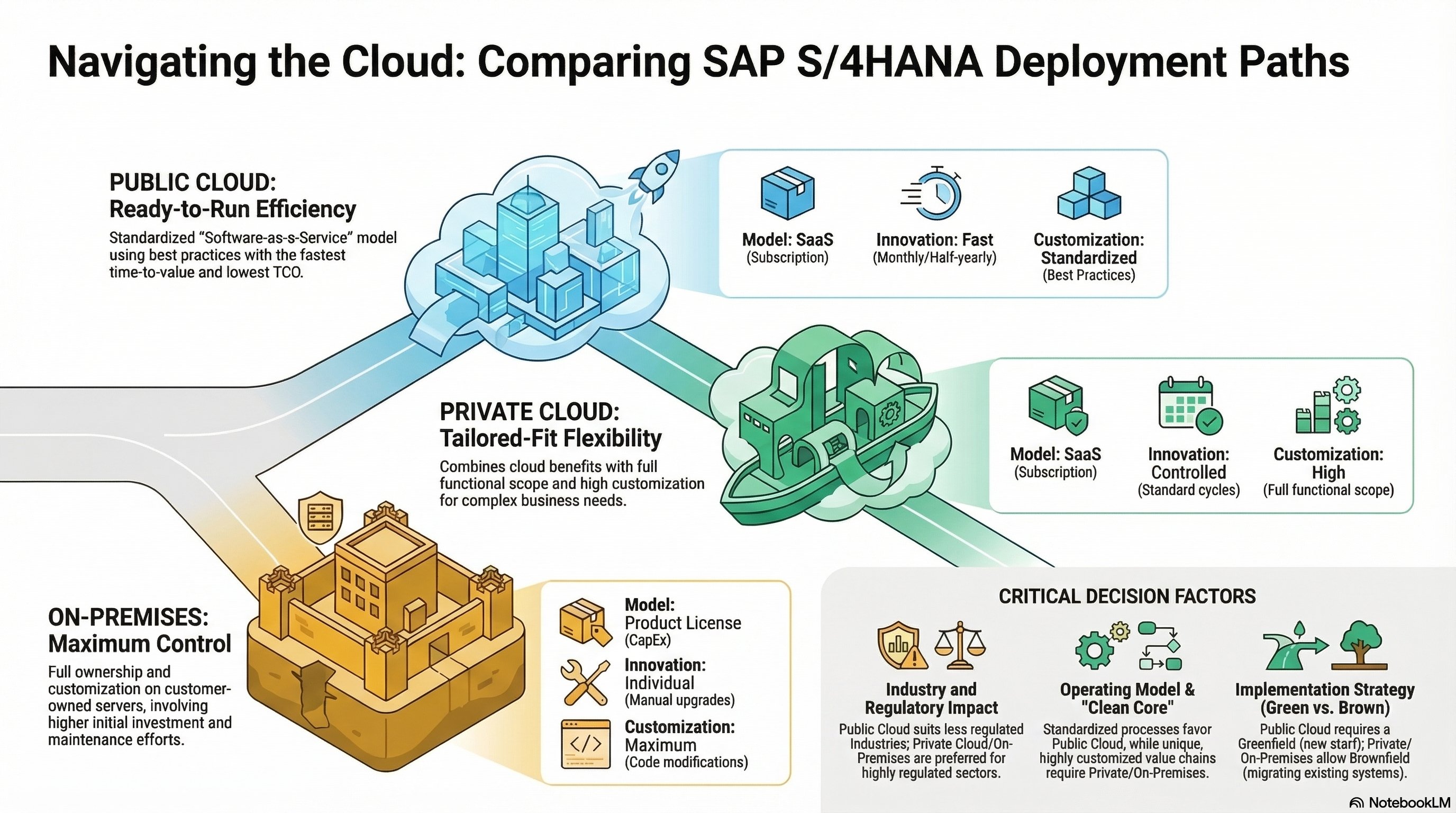
SAP Cloud ERP (formerly Public Cloud): This is a multi-tenant architecture where the system resides in SAP's own data center. The responsibility for installation, operation, maintenance, and updates lies 100% with SAP. This variant is characterized by highly standardized Best Practices, which significantly reduces implementation effort. New features are delivered monthly here, with major releases every six months. Large upgrade projects are thus completely eliminated.
-
SAP Cloud ERP Private (formerly Private Cloud): This variant is based on a single-tenant architecture. Technically, the system is operated either in SAP's data center or by a hyperscaler (such as AWS or Microsoft Azure). The functional scope corresponds to that of the on-premises world, and the core can be fully and custom-modified. The release cycles here are of a classic nature: upgrades are not applied automatically but must be individually controlled and analyzed.
-
On-Premises: The classic deployment on company-owned servers. This version offers full control through modifications at the code level, but requires full assumption of operating and maintenance costs. Moving from SAP ECC to S/4HANA using the so-called Brownfield approach is historically only possible for the Private Cloud and On-Premises.
Regarding licensing, there is a sharp cut: While on-premises solutions are licensed as Software-as-a-Product with high one-time investments (CapEx), the cloud editions follow a Software-as-a-Service (SaaS) model. The costs scale flexibly here based on so-called Full User Equivalents (FUE).
The 5 Crucial Factors for Cloud Transformation
When evaluating the right migration path (e.g., using the SAP Activate Methodology with its six phases and detailed fit-gap analyses in the "Prepare" and "Explore" phases), architects must consider five central factors:
-
Industry Requirements: For highly regulated industries, Private Cloud or hybrid models are often the preferred path, while less regulated industries benefit massively from the Public Cloud. With the August Release 248, SAP massively expanded industry coverage for the Public Cloud (e.g., Asset Retirement Obligations, Receipt Creation, and Subscription Billing in Consumer Products). Focus industries for future developments remain Retail, Consumer Products, Automotive, and the Public Sector.
-
Business Complexity: Tools like the Digital Discovery Assessment (DDA) have become essential to evaluate the extent to which standard processes apply.
-
Operating Model: Here, the question arises regarding the adaptation of standard processes as opposed to highly individualized processes.
-
IT Landscape: The decision between Greenfield implementations (predestined for the Public Edition) and Brownfield migrations.
-
Resources and Timeline: Limited budgets and fixed timelines predestine companies for Grow with SAP (Public Cloud-centric), while requirements for massive flexibility in architecture are covered by RISE with SAP (Private Cloud).
Deep Dive Extensibility & Clean Core Strategy in the Current Release
One of the most technically exciting areas is extensibility while adhering to the Clean Core Strategy. The strict separation of standard code and custom development is now possible across three architectural layers:
-
In-App Extensions (Key-User Extensibility).
-
On-Stack Development (Developer Extensibility) in the SAP S/4HANA Cloud ABAP Environment.
-
Side-by-Side Extensions via the SAP Business Technology Platform (BTP).
The technical depth that SAP delivers here in Release 248 is impressive: The system now offers over 750 pre-built integrations into the Public Cloud, more than 700 Open APIs, and over 6,000 usable CDS Views.
A groundbreaking innovation is the so-called Multi-off Extensibility: While in the past, in-app extensions were often written only for individual customers ("one-off"), these developments can now be versioned via GitHub and transported from one system to other systems. For 2025, a scalable approach is planned that allows developing ABAP Add-ons and deploying them across systems – a feature that already exists for BTP and is now being deeply integrated into the ABAP environment.
Additionally, the concept of "ABAP as an entity" in Identity Access Management (IAM) now enables even more granular authorization control, where specific ABAP code can be coupled to specific user roles. Furthermore, developers can now independently adapt and extend local country versions and industry-specific standard functions using the Localization as a self-service feature.
The AI Factor: Joule Copilot for Business and ABAP Development
Artificial Intelligence (Business AI) is natively anchored in the Cloud ERP. The AI assistant Joule now covers around 80% of the most frequently used navigation- and transaction-based tasks. With Release 2502, a massive amount of GenAI use cases is being rolled out, including Smart Summarization, Situation Handling, and seamless integration into the Microsoft Copilot.
Even more impressive are the new architectural tools for us developers: The Joule Copilot for ABAP Development revolutionizes code creation through three central pillars:
-
Joule Copilot Code Assist: Offers code completion and real-time explanations for development objects, massively supporting onboarding into complex codebases.
-
Joule Copilot Code Prediction: Predicts specific ABAP code based on context that exactly matches the respective language version.
-
ABAP Cloud Model Generator: This function, part of the 2025 roadmap, will automatically generate complete ABAP Cloud Model Business Objects – a massive acceleration for Greenfield and Side-by-Side projects.
Landscape Management, SLA, and Migration
There are also hard technical upgrades in operative basis management (SAP Cloud ALM). Landscape Management today guarantees a contractual SLA of 99.9%. Historical pain points like system downtime during upgrades have been massively optimized: The downtime reduction for all cloud services is now a maximum of 8 hours.
For the seamless transition of old data structures, the Data Migration Cockpit is continuously expanded with new migration objects for master and transactional data. Architecturally particularly valuable for hybrid landscapes and complex implementations is the Parallel Project Line (PPL). This feature allows a parallel system landscape alongside the productive 3-system setup (Development, Test/Quality, Production), which can be used for isolated testing of data migrations, rollouts, or as an early adapter system. The PPL is expected to go live with Release 2502 as "PGA" (Productively Generally Available). To increase adoption in these landscapes, SAP also uses In-App Recommendations to send specific users targeted embedded notifications about relevant new features for their role.
Conclusion
The SAP ecosystem is radically transforming from a historically rigid on-premises architecture to an agile, "Suite first"-driven cloud ecosystem. The renaming to SAP Cloud ERP and SAP Cloud ERP Private is more than just marketing – it marks the point where the cloud variants have achieved functional parity and, in some cases, superiority in development speed compared to classic systems in terms of extensibility (over 700 Open APIs, 6000+ CDS views, Multi-off GitHub integration). The integration of generative AI through the Joule Copilot deep into the ABAP development environment, combined with highly available SLAs of 99.9%, shows that the platform is ready for highly complex, mission-critical workloads. As a technology consultant, it is clear: The path leads via the rigorous application of the SAP Activate Methodology and the Clean Core Strategy directly into the connected, data-driven Business Data Cloud of tomorrow.