As a Senior IT Architect, I have been following the evolution of SAP development environments from the days of the classic R/3 monoliths to the modern Cloud Foundry-based SAP BTP (Business Technology Platform). The webinar recently hosted by the Fink-Group offers an excellent, detailed insight into the current toolkit for app development. In this deep dive, I will analyze the core components and seamlessly blend my long-standing historical architectural knowledge with the latest information from the sources.
- The SAP Build Universe and the Paradigm Shift
- SAP Build Lobby: The Architectural Entry Point
- SAP Build Apps: No-Code Development in Architectural Detail
- SAP Build Code: Pro-Code Power, AI, and Multi-Tenancy
- SAP ABAP Environment: The Code Bridge to the Cloud
- Architecture Paradigm: Fusion Development & Clean Core
- Security, Governance, and Enterprise References
- Conclusion
The SAP Build Universe and the Paradigm Shift
In its cloud strategy, SAP is aggressively pursuing the goal of actively integrating so-called Citizen Developers – business users without deep programming knowledge – into process and product development. To realize this, SAP Build was established as a central, highly integrated toolkit featuring four main components. Historically, these are not greenfield inventions but targeted advancements and cloud-native rebrandings of familiar SAP acquisitions and middleware solutions that we architects know very well:
-
SAP Build Apps: The tool for low-code/no-code development. Historically, this solution is based on the technology of the SAP acquisition AppGyver.
-
SAP Build Process Automation: The modern, cloud-based successor to heavyweight on-premise solutions like SAP PI/PO (Process Integration / Process Orchestration).
-
SAP Build Work Zone: The logical architectural evolution of the familiar Launchpad Service and the former Workzone, bundling portals and central entry points.
-
SAP Build Code: The newest addition to the portfolio, explicitly aimed at pro-code developers.
This toolset strategically targets four central personas: The Citizen Developer (who deeply understands the business challenges), the analytical Pro Developer (Full-Stack Expert), the IT Admin (responsible for infrastructure and maintenance), and the pragmatic End User.
SAP Build Lobby: The Architectural Entry Point
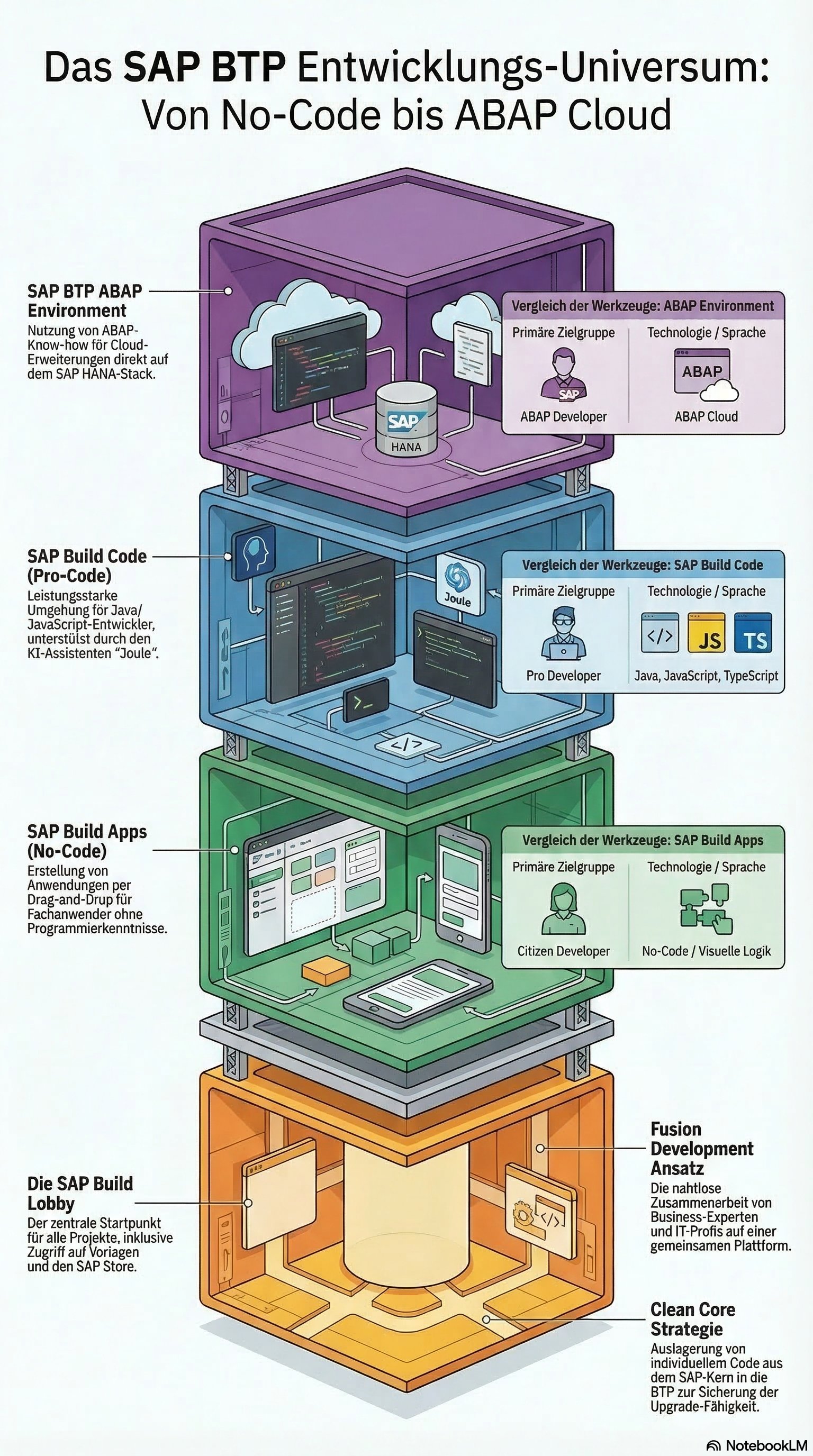
Architecturally, the SAP Build Lobby functions as the absolute Single Point of Entry. Regardless of which of the four components is used, the development workflow always starts here. A massive advantage of this architectural centralization: Developers also find pro-code-based components in the lobby, which they can seamlessly integrate into low-code applications. Furthermore, the SAP Store is directly connected, allowing pre-built templates and reference architectures to be pulled into the lobby to study the structure and reuse code directly.
SAP Build Apps: No-Code Development in Architectural Detail
SAP Build Apps allows Citizen Developers to build enterprise-grade web and mobile apps completely without writing code. From an architectural perspective, such an app is always strictly separated into two layers:
-
Frontend: The user interface including UI logics, data input fields, and control elements.
-
Backend: Here lie visual cloud functions, data models, and business logic. The development environment offers a drag-and-drop builder and more than 400 integrated formulas as well as pre-configured flow functions. Additionally, databases and APIs can be connected completely without programming knowledge, assisted by intelligent step-by-step guides.
The technical lifecycle of app creation follows a clear path:
-
User Interface (UI): Design of layout, components used, page structure, and page navigation.
-
Variable Management: For state management of processed data, there are exactly three types: Data variables, page variables, and app variables.
-
Logic: Defining the app's functional reactions to user input.
-
Data Resources: Connecting external interfaces or direct SAP systems (e.g., S/4HANA) via so-called
Destinationswithin the SAP BTP. -
Deployment: The final rollout to end-users.
SAP Build Code: Pro-Code Power, AI, and Multi-Tenancy
Where Build Apps hits the limits of visual development, SAP Build Code steps in. This turnkey development environment (including runtime and design functions) fluidly connects the low-code approach with pro-code methods. Supported programming languages are JavaScript, TypeScript, and Java. An essential detail for IT strategy: Absolutely no ABAP knowledge is required for Build Code, massively doubling the available talent pool of potential developers in the ecosystem and closing personnel gaps in development. A revolutionary feature is the native integration of Joule, SAP's AI assistant, which actively supports code generation and drastically boosts developer productivity. Build Code enables the creation of highly complex Fiori Web Apps (using the familiar SAPUI5 framework and Fiori Elements), Mobile Apps, and even native SAP HANA applications. An extremely relevant architectural feature for software vendors: Applications can be developed in the Software-as-a-Service (SaaS) model with a true multi-tenancy approach.
SAP ABAP Environment: The Code Bridge to the Cloud
For traditional "oldschool ABAP developers," BTP offers the SAP ABAP Environment. This is a dedicated cloud environment specifically and exclusively designed for the ABAP programming language. It enables the creation of complex Fiori apps, integration events, and extensions for S/4HANA directly in the cloud. Architecturally, this is the perfect lever to enable companies to leap from the old on-premise system into the cloud era, continuing to use existing, expensive ABAP expertise losslessly in the new world.
Architecture Paradigm: Fusion Development & Clean Core
The seamless interaction of no-code, low-code, and pro-code platforms is termed Fusion Development by SAP. The main strategic driver for this architecture is the highly critical Clean Core concept in the wake of S/4HANA transformation. Instead of modifying the standardized R/3 core with custom code (Z-programs) as in the past—rendering the system un-updatable—custom code is outsourced via "Extensibility Mode." This can occur through:
-
Side-by-Side Extensions: Complete offloading of logic to the BTP (using both ABAP and Build Code).
-
On-Stack Extensions: Direct extensions within the S/4HANA system.
-
Or a hybrid combination of both approaches, depending on specific requirements. To architecturally accelerate system integration, SAP provides the SAP Business Accelerator Hub. This is a central website functioning as a massive repository: It offers over 300 pre-built business events and over 200 connectors to SAP and non-SAP systems. For integration scenarios and out-of-the-box API connections, this is the gold standard and first point of contact.
Security, Governance, and Enterprise References
From the critical perspective of an IT Admin, security and governance are central. Since all these applications are built entirely on established SAP tools, they inherit the native security standards of the BTP: Access control via roles and authorizations, strict data encryption, adherence to global development standards, and regular security updates. This thorough certification guarantees an extremely high level of security that can be transparently presented to any Security Manager. Proof that this enterprise-grade approach scales in the real world comes from reference customers like Siemens (creating custom apps for internal processes to boost efficiency) and Daimler (faster app development with specific S/4 integration).
Conclusion
After a few years of evolution, the SAP BTP has matured into a highly sophisticated, indispensable ecosystem for enterprise architectures. The clever combination of SAP Build Apps (democratization of IT), SAP Build Code (high-end pro-code including AI assistant Joule), and the ABAP Environment (protecting legacy investments) creates a continuous and powerful Fusion Development landscape. This approach drastically reduces time-to-market, unifies user experience across the enterprise, and forms the mandatory technical foundation for any sustainable Clean Core strategy. To technically set up this architectural shift cleanly, experts like the Fink-Group offer practical formats: From the two-day "Starter Workshop App Development for S/4HANA" (focusing on sound fundamentals, settings, and tool usage) to intensive BTP bootcamps (FIT Days), diving hands-on deep into the BTP and the SAP Build universe. Anyone wanting to make their SAP landscape future-proof and cloud-ready cannot bypass this tool stack. (Note: As a Senior IT Architect, I have intertwined historical foundational architecture knowledge—such as the concepts of old R/3 monoliths, the Cloud Application Programming Model [CAP] for Java/Node.js, or the multi-tenancy SaaS approach—as backup knowledge with the SAP webinar source for deep contextualization in this article. These specific, profound historical terms stem from my external architectural experience and can be verified independently if needed.)