Welcome back to the architectural drawing board! By mid-2024, the ink on SAP's acquisition of LeanIX has completely dried, and strategic integration is running at full speed. Many initially asked: Why does SAP need another architecture tool after Signavio? The answer lies in the most massive challenge of our time: The hard, measurable enforcement of the Clean Core strategy in S/4HANA transformations.
As an Enterprise Architect, today I take an unvarnished look at SAP's architectural triangle, the LeanIX meta-model, and how we finally make technical debt (Z-code) from the ERP basement transparent on C-level dashboards.
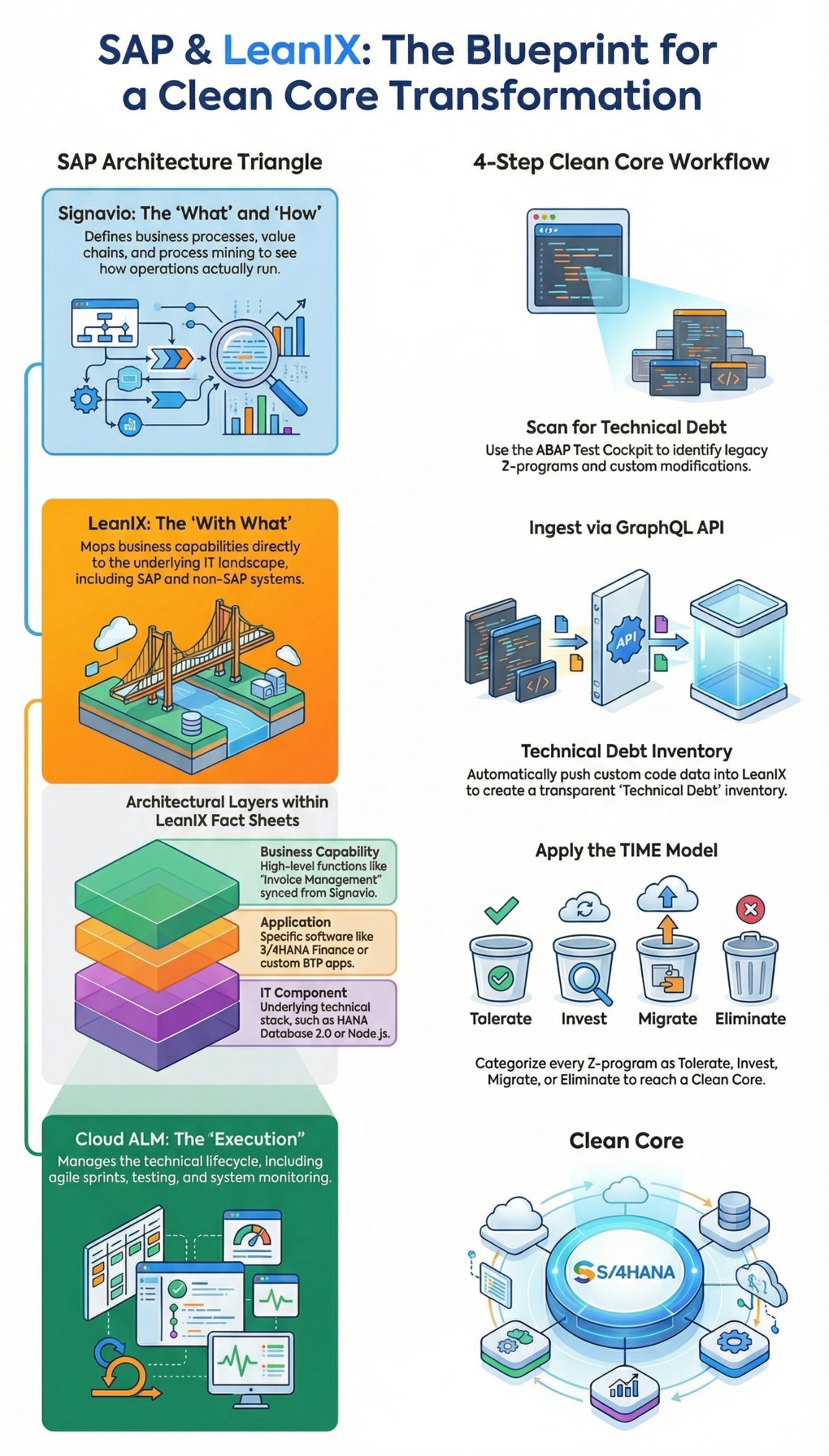
The Architecture Triangle: Signavio + LeanIX + Cloud ALM
To understand LeanIX's right to exist in the SAP ecosystem, we must redraw the landscape map. For a long time, business and IT operated in complete silos.
-
SAP Signavio (Business Process Management): Defines the What and How. Value chains (Order-to-Cash), BPMN diagrams, and Process Mining (Which process is actually spiraling out of control in reality?) are mapped here.
-
SAP Cloud ALM (Application Lifecycle Management): Defines the Doing. This is where agile sprints, transport requests, test management, and monitoring of running systems reside.
-
LeanIX (Enterprise Architecture Management): This was the missing puzzle piece. LeanIX defines With What. It maps the business capabilities from Signavio exactly to the underlying IT landscape (which SAP system, which BTP app, which external SaaS service supports this process?).
Deep Dive: The LeanIX Meta-Model (Fact Sheets)
The brilliance of LeanIX lies in its highly standardized yet flexible meta-model based on so-called Fact Sheets. Instead of drawing Visio diagrams, architects maintain database-backed objects linked via relations.
The most important architectural layers for us:
-
Business Capability: (e.g., "Invoice Management"). Ideally synchronized bidirectionally with Signavio.
-
Application: (e.g., "S/4HANA Finance" or "BTP Custom App - Invoice Splitter").
-
IT Component: (e.g., "HANA Database 2.0 SPS07", "Node.js Runtime").
-
Provider / Tech Category: To manage vendor lock-ins or End-of-Life (EOL) cycles.
If SAP now announces that mainstream support for a NetWeaver 7.5 system is ending, LeanIX uses dependency graphs to show in milliseconds which business capabilities and departments are directly affected. The days of "We are looking for the affected systems in an outdated Excel list" are over.
Making Clean Core Measurable: The API Integration
The "Clean Core" is the mantra of every S/4HANA Cloud (PCE or Public) implementation. No modifications in the core, relocation of Z-code to the SAP BTP (Side-by-Side Extensibility), or use of Key User Extensibility.
The problem: How does the Head of IT prove to the CIO that the system is truly becoming "clean"? This is where LeanIX acts as the Single Source of Truth by feeding it via its powerful GraphQL API.
An architectural best-practice approach (mid-2024):
-
Custom Code Scan: The SAP ABAP Test Cockpit (ATC) or the Custom Code Migration App scans the old ECC system for Z-programs, BAdIs, and User Exits.
-
Data Ingestion: Via an integration pipeline (e.g., on the BTP Integration Suite), these custom Z-developments are created as IT Components or Applications in LeanIX via a GraphQL
mutationand tagged as "Technical Debt". -
Lifecycle Management: In the LeanIX dashboard, every Z-program receives a clear lifecycle (TIME model):
-
Tolerate (Can remain for now)
-
Invest (Will be rebuilt on the BTP Cloud Application Programming Model)
-
Migrate (Will be replaced by a standard SAP S/4 Fiori app)
-
Eliminate (Will be completely deleted).
Conclusion for IT Architects
The acquisition of LeanIX is a brilliant move by SAP. It forces companies to no longer view their S/4HANA transformation as a pure "Basis infrastructure project" (Brownfield/Lift-and-Shift) but as an architectural rebirth.
For us as SAP Consultants and Basis Administrators, this means an evolution of our job profile. Merely managing transport requests (STMS) and database parameters is no longer sufficient. The future belongs to the Enterprise Architects who manage the code lifecycle, inventory BTP microservices in LeanIX, and bridge the gap between the Signavio BPMN model and the physical HANA database. LeanIX finally makes the abstract "Clean Core" tangible and measurable – and mercilessly exposes any architectural wild growth.