Hello tech community and IT architects, welcome back to the blog! Today we dedicate ourselves to a true heavyweight of Enterprise IT: The deployment of SAP systems on Amazon Web Services (AWS). As a Senior IT Architect, I have been guiding massive migration projects for years, and the symbiosis of SAP's powerful ERP engine and the highly scalable infrastructure of AWS is an absolute gamechanger for any modern IT strategy. In this deep dive, we analyze the architectural foundations, historical developments, and hard technical facts of this integration.
- The Historical Baseline and Strategic Evolution
- The Architecture Layers: Who is Responsible for What?
- AWS CloudFormation and SAP HANA Implementation
- Integration of Classic and Innovative Cloud Services
- Hosting, Hybrid Scenarios, and Disaster Recovery
- The 4 Central Advantages of the SAP-AWS Symbiosis
- The Challenge: Connectivity and Migration
- Conclusion
The Historical Baseline and Strategic Evolution
When we talk about the architecture of SAP on AWS, we must understand that this is not a short-term market reaction. Amazon and SAP have been collaborating intensively since 2011. The primary goal of this long-standing cooperation is to provide a significant acceleration of digital transformation. Historically, certifying on-premise hardware for SAP was extremely rigid. Through the cloud alliance, however, SAP applications and complex databases are intended to be certified much more easily to lower resulting distribution costs. For us architects and for third-party companies, this cooperation offers countless possibilities: It creates a broad and diverse connection of numerous cloud services that help continuously increase operational efficiency in the long run.
The Architecture Layers: Who is Responsible for What?
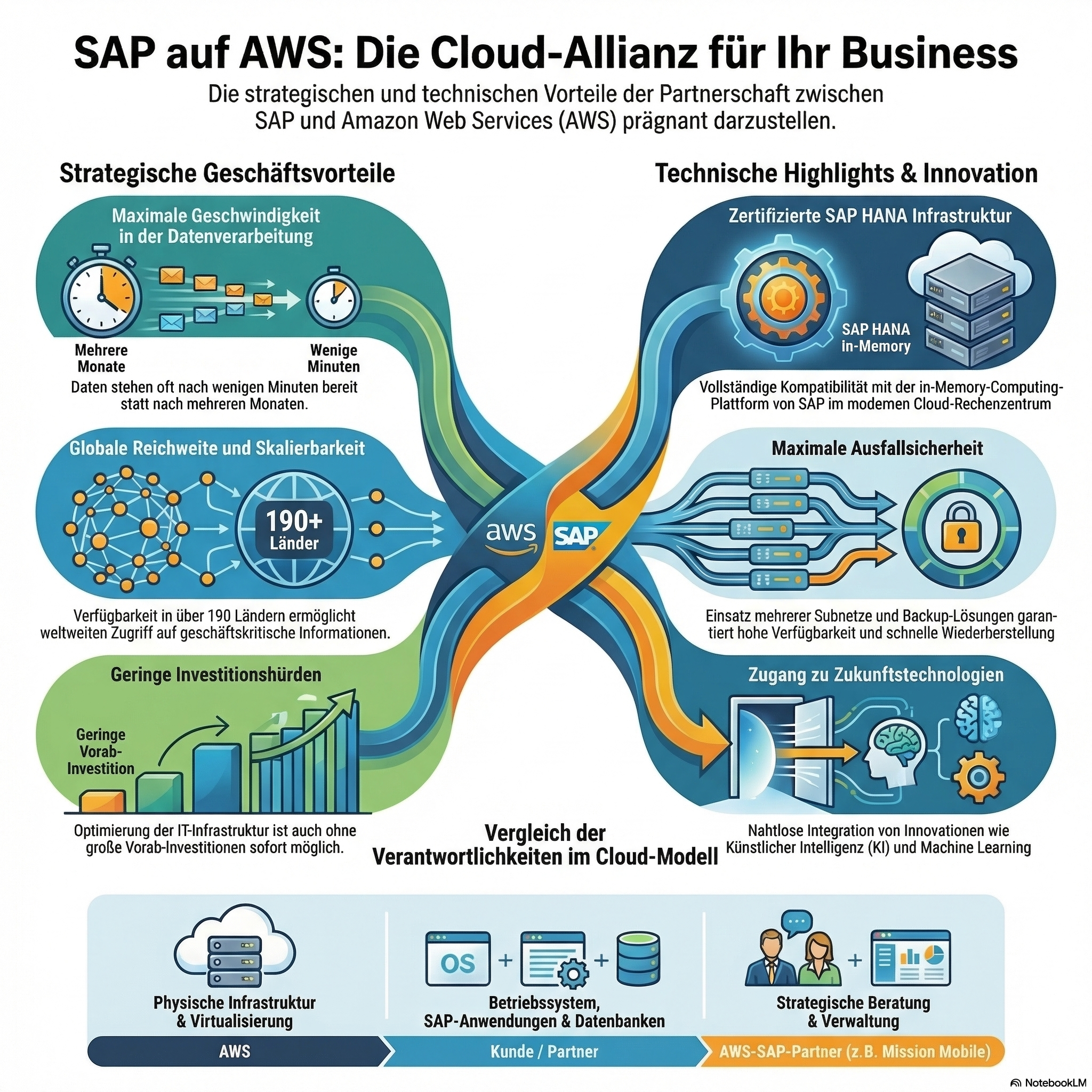
A core concept of any cloud design is the Shared Responsibility Model. In the context of SAP AWS, this means: AWS, as the Infrastructure-as-a-Service (IaaS) provider, manages the physical infrastructure up to the virtualization layer. The operating system, as well as all SAP applications and databases running atop this virtualization layer, however, are completely managed by the customer. This gives us full control over OS tuning, while we no longer have to worry about broken hard drives or hypervisor-level patching. Should a company require a comprehensive management service for this, AWS has an extensive network of partners offering SAP consulting and management services directly within AWS.
AWS CloudFormation and SAP HANA Implementation
True complexity reveals itself at the configuration level. The architecture of the combined solution is quite complex, as AWS CloudFormation relies on firm foundations and standardized templates. These rigid structures mean that managing and structuring data is only possible within a limited scope strictly dictated by the AWS framework. While custom adaptations and scripting can alter these layers, they always remain restricted to the system's given conditions. But this is exactly where SAP HANA unfolds its strengths. Amazon Web Services offers an SAP-officially certified cloud infrastructure that is fully compatible with SAP HANA. Users can now utilize all the enormous advantages of SAP HANA's in-memory computing platform on AWS to the fullest extent. With SAP HANA software, all applications required for desired usage can be implemented directly within the system. To achieve significantly higher availability (High Availability) at the architectural level, the use of multiple subnets (Multi-AZ deployments) is pushed in practice. The systems themselves are always maximally scalable here and can be completely rewritten and adapted according to the specific wishes and requirements of the enterprise.
Integration of Classic and Innovative Cloud Services
Linking both worlds aims for comprehensive business optimization. Especially for larger companies and enterprise environments, this forms an excellent foundation for designing all workloads as flexibly and maximally securely as possible by running SAP system solutions directly via the Amazon Web Service. Usable services include not only classic services like processing, storing, and provisioning databases but also highly innovative, newer technologies such as Artificial Intelligence (AI) and Machine Learning. These advanced services can be ideally combined in specific applications.
Hosting, Hybrid Scenarios, and Disaster Recovery
Through continuous adaptation of the service systems, the foundational structure of SAP AWS is always up-to-date. These rapid developments and a multitude of new innovations create the desired foundation to remain as flexible as possible oneself and to be able to rely on an always secure application. This modern hosting makes it possible to benefit from integrable testing solutions and modern hybrid processes (connecting on-premise and cloud). As an IT Architect, I place the utmost value on resilience. Even in emergencies, robust recovery options and backup solutions provide users with sufficient options to secure all valuable SAP data and structures. Through targeted Bring-Your-Own-License (BYOL) concepts and specific licensing, it becomes easily possible on this infrastructure foundation to make SAP services usable in AWS at any time.
The 4 Central Advantages of the SAP-AWS Symbiosis
When we compare traditional on-premise hosting with the SAP AWS construct, four massive architectural advantages crystallize that automatically boost operational efficiency:
-
More Speed in Data Processing: The significantly higher performance of modern AWS servers enables a massive acceleration in data processing and storage. Unlike traditional hardware procurement processes, the desired data and systems are ready in just a few minutes, even when other systems might require several months for provisioning and availability.
-
Global Connectivity: SAP and AWS are characterized by unprecedented global reach, counting customers in more than 190 countries today. This immense reach has a positive impact on development, making data accessible anywhere in the world in the shortest possible time (via Edge Locations and global backbone).
-
Fostering Overall Data Migration: Providing an innovative partner system makes rapid retrofitting and smooth data migration possible within the company. Experienced supporters ensure modern management here.
-
No Huge Investments for Success: The classic CAPEX-to-OPEX model takes full effect here. Even if sufficient capital for a physical migration is unavailable, companies have the opportunity to undertake such a cloud transformation without a massive upfront payment.
The Challenge: Connectivity and Migration
Nothing in IT is without challenges. Such an effort for data migration makes many companies critical at first glance, as such a system retrofit involves much effort. In architectural practice, however, this should not become an unsolvable problem, since reformatting systems and retrofitting the associated IT infrastructure can be realized within a very short time. The enterprise thereby gains a completely new environment through which technical tasks and operational challenges are drastically simplified. Those who wish to securely evaluate these steps in advance can fall back on various SAP Test Drives, trial versions, and special developer images available directly in AWS.
Conclusion
The deep cooperation between Amazon and SAP, existing since 2011, has the clear goal of rapidly accelerating digitalization and allowing SAP applications and databases to be certified much more easily, ultimately lowering distribution costs. The consistent integration of AWS and SAP offers modern enterprises countless opportunities to boost operational effectiveness and leads to fundamental business optimization. Admittedly, the architecture of this combined solution, particularly when using AWS CloudFormation, is technologically quite complex and requires continuous adaptation of service systems to always be at the cutting edge of security and functionality. Nevertheless, the advantages far outweigh this: Significantly higher AWS server performance, seamless global connectivity, and targeted promotion of overall data migration are unbeatable arguments. The symbiosis of SAP and AWS thus sets completely new, lasting standards for enterprise architectures to profit from state-of-the-art cloud concepts like AI and in-memory computing, and to maximize internal IT flexibility in a future-proof manner. Whoever relies on this stack as an architect today builds the foundation for the next decade.