Welcome back, architecture colleagues! At the end of January 2021, SAP introduced its new strategic core offering with a massive bang: RISE with SAP. Marketing slogans are overflowing with terms like "Business Transformation as a Service" (BTaaS) and "One Offer, One Contract." But beyond the glossy presentations, what does this construct mean for us IT architects and SAP Basis administrators? Is it merely a commercial bundling of licenses or a genuine architectural paradigm shift?
In this deep dive, we dissect the technical and operational consequences of RISE with SAP. We take an unvarnished look at the new cloud operating model, the system landscapes, and the massive shift of responsibilities in IT operations.
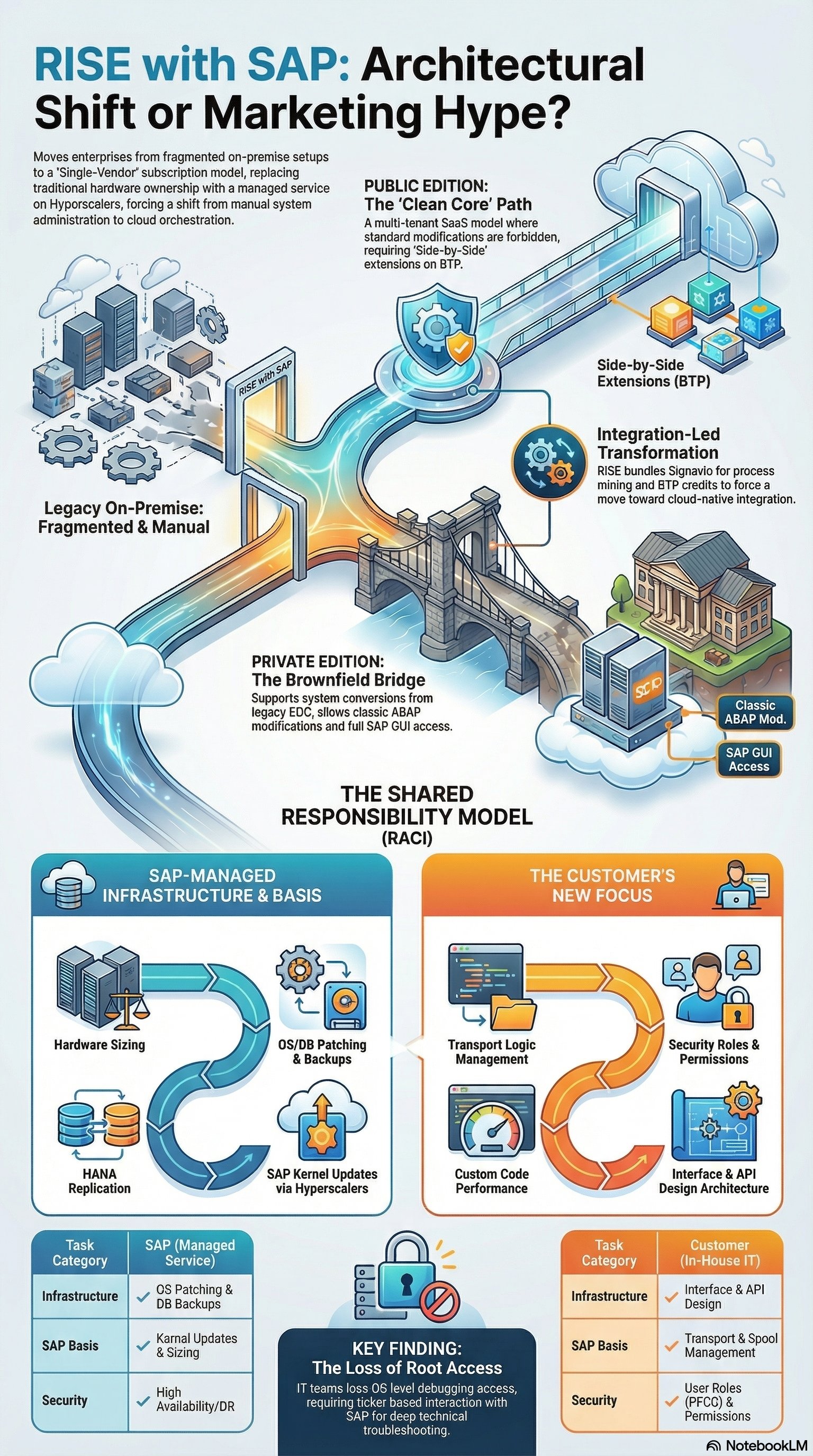
The Core of RISE: Unbundling On-Premise Shackles
Historically, purchasing SAP software was a highly fragmented process: Companies bought licenses from SAP, hardware from IBM or HP, database licenses from Oracle, and let system houses handle operations.
RISE with SAP ends this fragmentation through a single-vendor approach. A single contract (subscription) encompasses:
-
SAP S/4HANA Cloud (Public or Private Edition)
-
Infrastructure Hosting (IaaS) at a Hyperscaler (AWS, Azure, GCP), managed by SAP
-
Business Process Intelligence (SAP Signavio)
-
Cloud Credits for the SAP Business Technology Platform (BTP)
-
Access to the SAP Business Network (Ariba)
The Architecture Shift: Private Cloud vs. Public Cloud Edition
For technical system architecture, the choice of the S/4HANA edition is the decisive junction in RISE. SAP positions two drastically different cloud architectures here:
1. SAP S/4HANA Cloud, Public Edition
This is the radical "Greenfield" solution. A true SaaS model (Software as a Service) with a multi-tenant architecture.
-
Architecture Impact: Modifications to the SAP standard (the classic Z-namespace) are technically forbidden here. The absolute Clean Core approach prevails.
-
Extensibility: Developers must imperatively switch to In-App Extensibility (Key-User Tools) or Side-by-Side Extensibility (via API on the SAP BTP).
-
Target Audience: Companies willing to adapt their processes 100% to the SAP standard (Best Practices).
2. SAP S/4HANA Cloud, Private Edition (PCE)
This is the architectural "savior" for most existing customers and the primary driver of RISE.
-
Architecture Impact: The PCE is essentially a dedicated on-premise code line hosted by SAP on a hyperscaler. This means: System Conversions (Brownfield approach) from old ECC 6.0 systems are fully possible here.
-
Extensibility: Customers retain full access to transaction
S-PRO, the SAP GUI, and may continue programming in the Z-namespace. While SAP recommends Clean Core, it does not technically enforce it at this level.
The Shared Responsibility Model: The End of the Classic Basis Admin?
The most massive architectural impact of RISE affects IT operations. With the transition to the Private Cloud Edition (PCE), a rigid Shared Responsibility (RACI) Model between SAP and the customer takes effect.
SAP assumes (as a Managed Service Provider) the role of infrastructure and Basis administrator up to the operating system and database layer:
-
Hardware Provisioning & Sizing (via hyperscaler)
-
High Availability (HA) & Disaster Recovery (DR) Setups (e.g., Pacemaker Cluster, HANA System Replication)
-
Backups & Restores (using cloud-native Backint APIs)
-
OS and DB Patching (Linux Kernel, HANA Revisions)
-
SAP Kernel Updates
What remains for in-house IT? The transformation from Basis Admin to Cloud & Integration Architect. The customer remains responsible for:
-
Transport Management (Transport Organizer, ChaRM)
-
Authorization concepts (PFCG, Fiori roles)
-
Printer configurations and Spool Management
-
Custom code analysis and performance tuning
-
Interface architecture (SAP Cloud Connector, Integration Suite)
The Role of Signavio and SAP BTP in RISE
SAP recognized that a pure "Lift and Shift" migration of ECC to the cloud (merely moving virtual machines) brings no business value. Therefore, RISE mandatorily integrates two essential tools into the target architecture:
1. Business Process Intelligence (SAP Signavio): Before the migration, the customer's processes are scanned using Process Mining technologies. Signavio analyzes which custom codes and workflows are actually used in the old ERP, where bottlenecks lie, and which processes can be replaced by SAP standard Best Practices in the new S/4HANA.
2. SAP Business Technology Platform (BTP): Since "Clean Core" is the strategic directive, RISE includes so-called Cloud Platform Enterprise Agreement (CPEA) credits. These essentially architecturally force customers to build up the BTP. Outdated on-premise middleware (like SAP PI/PO) must be replaced by the SAP Integration Suite. Custom developments migrate as Node.js/Java microservices into the Cloud Foundry or Kyma runtime environment.
Criticism and Architectural Pitfalls
Despite the brilliant concept, as architects, we must clearly state the pitfalls of RISE 2021:
-
Loss of Infrastructure Control: In the event of performance issues at the database level, in-house admins often lack root access (e.g., to the Linux host) to perform in-depth traces (like
straceor OS-level debugging). Every intervention requires a ticket with the SAP Enterprise Cloud Services (ECS) team, which can lead to SLA latencies. -
Hyperscaler Lock-In via SAP: Although the customer chooses the hyperscaler (AWS, Azure, GCP), the contractual partner remains SAP. Native hyperscaler features (like Azure NetApp Files or AWS Nitro) are abstracted by SAP and cannot be individually parameterized across their full bandwidth by the customer.
Conclusion
RISE with SAP is far more than just a clever marketing bundle or a new licensing model. It is a massive architectural shift. SAP is no longer positioning itself merely as a software vendor, but as a full-service Managed Service Provider of the infrastructure.
For companies, this means: The days when server sizing, SAN storage provisioning, and tape backups blocked IT departments for months are finally over. The Private Cloud Edition (PCE) builds a golden bridge for legacy customers to safely complete the S/4HANA transformation. For us Senior Architects, the focus now shifts drastically: Away from the command line (su - <sid>adm) and storage LUNs, towards orchestrating hybrid integration scenarios on the SAP BTP and enforcing the Clean Core paradigm. Those who understand and embrace this paradigm shift secure the technological survival of their company in the current cloud decade.